

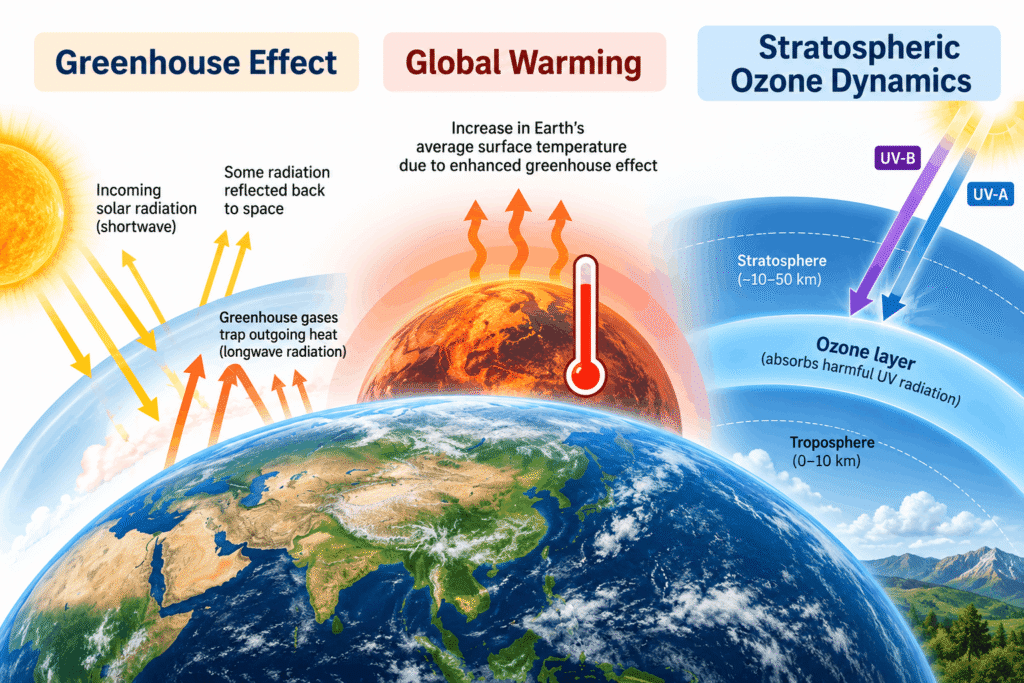
In agricultural meteorology and atmospheric science, the Greenhouse Effect and Ozone Layer Protection are two core thermal and radiation regulators of the biosphere. For a UPSC Agriculture Optional candidate, these concepts must be understood through their exact physical mechanisms, their role in maintaining global temperatures, and how changes in these systems affect crop leaves and macro-climatic systems.
1. The Physical Mechanism of the Greenhouse Effect
The greenhouse effect can be explained by comparing it to a physical greenhouse used to grow temperature-sensitive plants:
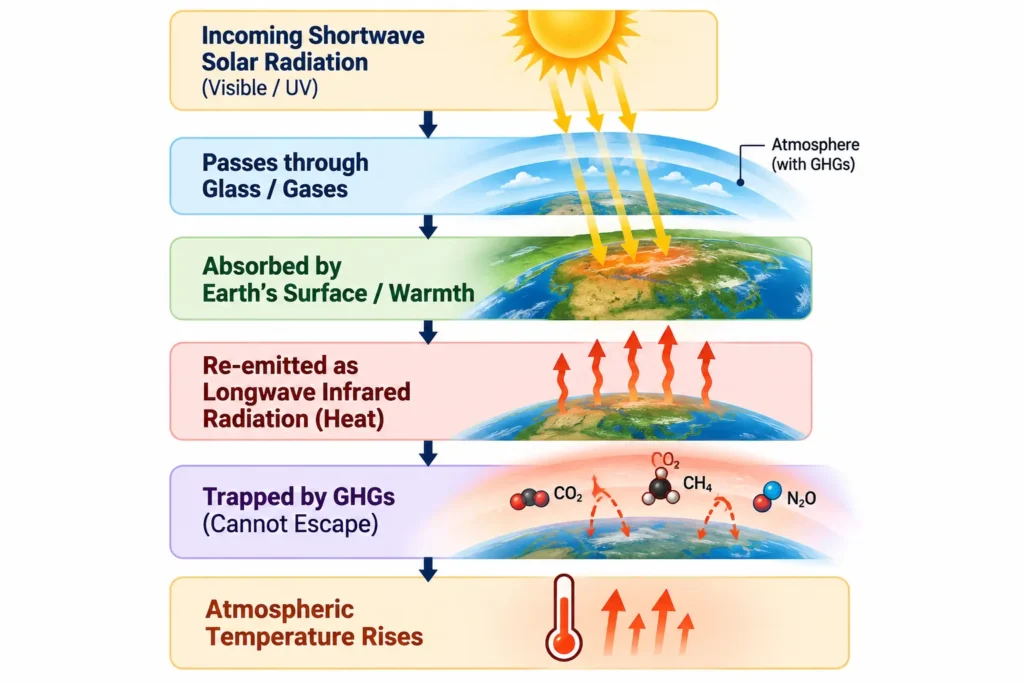
- Shortwave Radiation Entry: Incoming solar radiation consists of shortwave energy (visible light, adjacent ultraviolet, and shortwave infrared). This shortwave energy easily passes through the transparent glass of a greenhouse or the greenhouse gases in the atmosphere.
- Absorption and Ground Warming: This energy is absorbed by the earth’s surface, floor, and canopy contents, warming the ground.
- Longwave Infrared Re-emission: The warmed earth re-emits this energy back toward space as longer-wavelength infrared radiation (heat radiation).
- Acoustic and Atmospheric Trapping: Glass walls and atmospheric greenhouse gases are opaque to longwave infrared radiation; they do not allow it to pass through. Because the greenhouse structure is closed, heat cannot escape via convection or radiative transfer, causing the internal temperature to rise.
2. Importance of the Natural Greenhouse Effect
The greenhouse effect is a vital natural phenomenon that has maintained the earth’s climate equilibrium for millions of years.
- Water Vapor Baseline: Over 95% of total natural greenhouse warming is driven by water vapor and small water particles suspended in the atmosphere.
- Thermal Homeostasis: This natural blanket maintains the average global surface temperature at a hospitable 15°C.
- The Absolute Criticality: Without this natural heat trapping, the average global surface temperature would drop to approximately -17°C. At this freezing temperature, water would lock into ice sheets, biological metabolic pathways would freeze, and agricultural life could not exist.
3. Atmospheric Greenhouse Gases (GHGs) vs. Cooling Gases
Atmospheric gases vary significantly in their molecular structure and how they interact with radiant heat energy:
I. Primary Greenhouse Gases (Heat Trappers)
Gases like Carbon Dioxide (CO2), Methane (CH4), Nitrous Oxide (N2O) water vapor, and Chlorofluorocarbons (CFCs) possess complex molecular shapes. These shapes allow them to absorb and re-emit outgoing longwave infrared radiation, trapping heat within the troposphere.
II. Gaseous Distinctions and Cooling Elements
- Nitrous Oxide (N2O): A potent greenhouse gas released primarily via agricultural soil management and excessive synthetic nitrogenous fertilizer applications.
- Oxides of Nitrogen (NOx such as NO and NO2): Unlike N2O, standard primary oxides of nitrogen act as global cooling gases. They react to form nitrate aerosols that reflect incoming solar radiation back into space, reducing the amount of solar energy that reaches the ground.
Global Warming, Soil Carbon Sequestration, and Ozone Layer Depletion – UPSC Agriculture Optional
In agricultural ecology, plant protection, and soil management, evaluating climate change requires a clear understanding of three linked processes: global warming, soil carbon sequestration, and stratospheric ozone depletion. For a UPSC Agriculture Optional candidate, these concepts explain how human activities change the weather, how these changes affect crops and pests, and how smart farming can turn agricultural soils into a natural defense against global warming.
1. Global Warming: Causes and Agronomic Vulnerabilities
Global warming is the long-term heating of Earth’s climate system observed since the pre-industrial period (between 1850 and 1900) due to human activities. By increasing the levels of greenhouse gases in the atmosphere, these activities trap extra heat and alter the global climate.
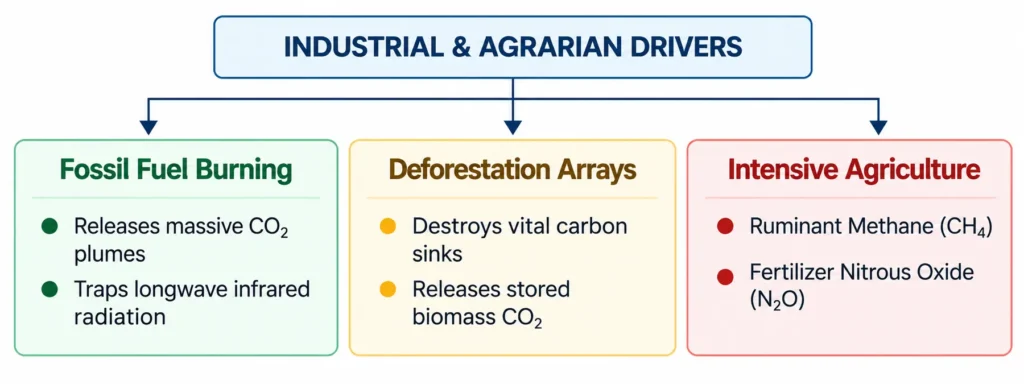
Primary Anthropogenic Causes
- Fossil Fuel Combustion: Burning coal, oil, and natural gas for electricity and transport releases massive amounts of CO2 into the atmosphere.
- Deforestation and Land Clearing: Clearing forests for farming and infrastructure destroys vital carbon sinks. When vegetation is cut or burned, its stored carbon is released back into the air as CO2. This clearing removes a key biological tool needed to limit global warming to the 1.5°C target.
- Intensive Livestock and Farming: Ruminant livestock (such as cattle and sheep) produce methane (CH4) during digestion. On a large scale, this methane acts as a potent greenhouse gas. Additionally, the unbalanced use of chemical fertilizers releases nitrous oxide (N2O) from the soil.
The Developing Economy Disparity
Agriculture makes up a much larger share of developing economies than of industrial nations. Developing countries are generally more vulnerable to the impacts of global warming due to two key reasons:
- Lower Adaptive Capacity: Smallholders in developing regions lack the financial resources and technology needed to adapt quickly to rapid climate shifts.
- Extreme Baseline Temperatures: Most developing countries are located in warmer parts of the world. In these zones, baseline temperatures are already close to or past the strict biological thresholds where further warming reduces rather than increases crop yields.
Impact Matrix on Crop Production
- Pest Insect Population Booms: Warmer temperatures speed up the metabolic rates and increase the number of breeding cycles of insect pests. This can lead to insect population explosions that severely damage staple crops like wheat and soybeans.
- Changing Precipitation Patterns: Rainfall patterns are shifting across continents, causing an increase in both intense stretches of heavy rain and longer dry spells within the same farming region.
- Changing Temperature Regimes: Rising average temperatures, year-round heatwaves, fewer cool days during winter, and frequent cold-season thaws disrupt the traditional winter chilling hours required by temperate crops.
2. Advanced Cropping Practices for Soil Carbon Sequestration
Agriculture can transition from being a source of greenhouse gases to acting as a functional sink for CO2 storage. By adopting specific agronomic practices, farmers can increase soil organic matter, improve soil structure, and capture carbon long-term.
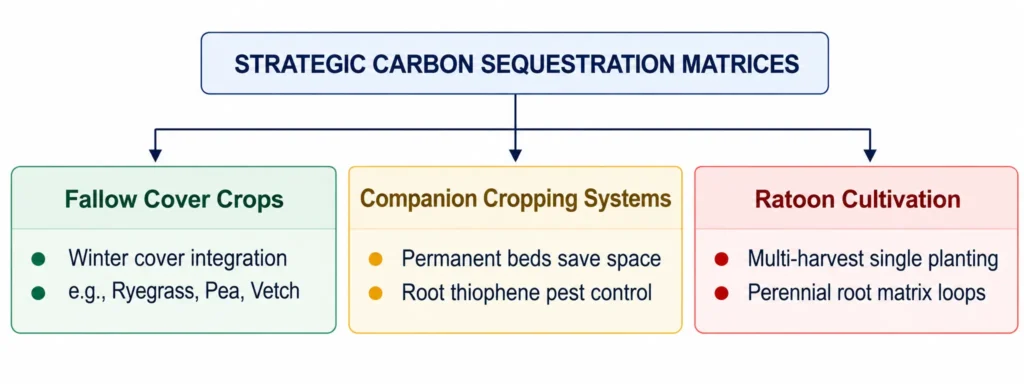
- Fallow Cover Cropping: Planting crops like ryegrass, oats, field peas, vetch, and clover during the fall off-season. These plants survive mild winters and resume growth in spring, keeping the soil covered, preventing erosion, and adding organic carbon back into the soil matrix.
- Companion Cropping and Trapping Systems: In organic vegetable systems, growing companion crops in permanent beds alongside main vegetables (like lettuce and cabbage) provides a sustainable alternative to chemical controls.
- Trapping Effect Example: Planting collards near cabbage fields acts as a natural trap crop. Collards are highly attractive to the diamondback moth (Plutella xylostella), drawing the pest away from the main cabbage crop.
- Biochemical Pest Suppression: Some companion plants exude protective chemicals from their roots or leaves. For example, the African marigold (Tagetes erecta) releases thiophene, a natural nematode repellent that protects nearby garden crops.
- Nursing and Shading Effects: Tall, dense companion plants protect vulnerable understory crops. For instance, oats are used as a nurse crop to help establish young alfalfa and other forage plants by providing shade and acting as a windbreak.
- Ratoon Cropping: A method where a single planting yields two or more subsequent harvests. This practice requires crops with a well-developed root system, early maturity, and a perennial nature (such as sugarcane or certain rice varieties). Ratoon cropping keeps the soil undisturbed and increases soil carbon sequestration by leaving root networks intact.
Benefits of Soil Carbon Sequestration
- Atmospheric Cooling: Reduces ambient CO2 levels, helping to lower regional temperatures.
- Soil Health and Erosion Control: High organic matter improves soil aggregate structure and reduces water and wind erosion.
- Nutrient Retention: Minimizes nutrient leaching losses and supports a steady root growth zone.
- Habitat Conservation: Maintains a healthy biological habitat for beneficial soil micro- and macro-fauna.
3. Stratospheric Ozone Depletion: Causes and Biological Hazards
While tropospheric ozone acts as a greenhouse gas, the stratospheric ozone layer contains high concentrations of O3 that protect the biosphere by filtering out harmful ultraviolet (UV) radiation from the sun.
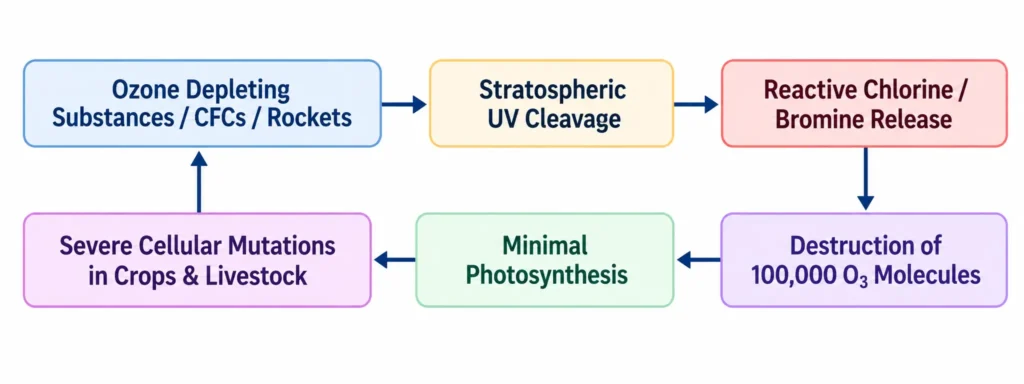
Primary Causes of Depletion
- Chlorofluorocarbons (CFCs): Emitted by industrial solvents, spray aerosols, commercial refrigerators, and air conditioning units. When CFCs reach the stratosphere, UV radiation breaks them down, releasing highly reactive chlorine atoms that attack and destroy ozone molecules.
- Unregulated Rocket Launches: Modern research indicates that unregulated rocket exhaust releases reactive chemicals directly into the upper atmosphere. Left unchecked, this could cause significant damage to the ozone layer by 2050.
- Nitrogenous Compounds: Gaseous nitrogen compounds (NO2, NO, N2O) are highly reactive and account for an estimated 2% of total ozone layer depletion.
- Geogenic Volcanic Eruptions: Major volcanic events inject sulfur aerosols and chlorine compounds directly into the stratosphere, accelerating natural ozone breakdown.
Environmental and Health Effects of Depletion
- Human Health Pathologies: Direct exposure to unfiltered UV rays damages human tissue, leading to an increase in skin cancers, severe sunburns, cataracts, accelerated skin aging, and a weakened immune system.
- Livestock Hazards: Elevated UV exposure causes skin and eye carcinomas in domestic farm animals and livestock.
- Crop Production Shocks: Strong UV rays damage plant leaf cells, resulting in reduced flowering, stunted growth, and lower photosynthetic rates, which limits yield across both field crops and forests.
- Marine Food Web Collapses: Unfiltered UV radiation destroys plankton in surface waters. Because plankton form the base of the aquatic food web, their decline creates a downward cascade that harms larger organisms throughout the marine ecosystem.
4. Integrated Preventive and Agronomic Mitigation Strategies
Reversing ozone layer depletion requires combining global industrial bans, national transport strategies, and clean agricultural practices:
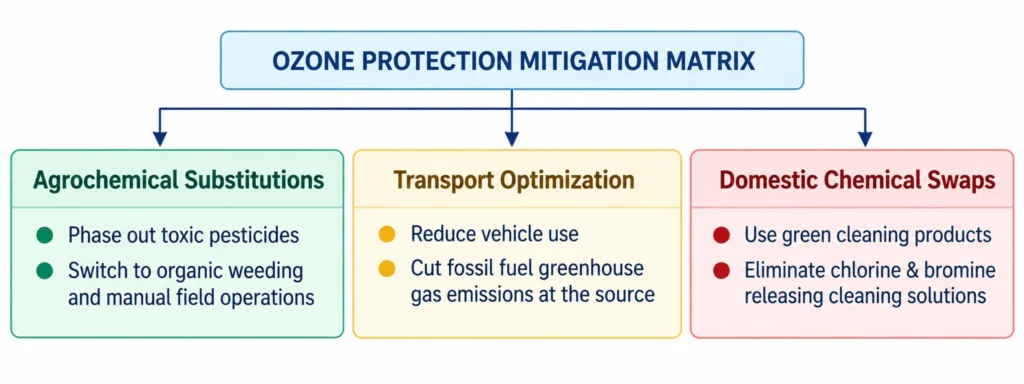
- Eliminating Ozone-Depleting Pesticides: Conventional chemical farming relies on synthetic pesticides and fumigants (such as Methyl Bromide, a potent ozone-depleting substance). Agricultural policy must prioritize natural methods to manage pests and weeds:
- Replacing synthetic inputs with eco-friendly chemical controls or biological treatments.
- Incorporating manual weeding operations and mechanical field management to eliminate toxic residues.
- Incorporating manual weeding operations and mechanical field management to eliminate toxic residues.Minimizing Vehicular Emissions: Reducing vehicle use lowers the emission of greenhouse gases and nitrogen oxides (NOx), which drive both global warming and stratospheric ozone breakdown.
- Using Eco-Friendly Cleaning Solutions: Replacing industrial and domestic cleaning products that contain chlorine and bromine with natural, biodegradable cleaning agents to prevent these reactive halogens from entering the atmosphere.
- Statutory Bans on Nitrous Oxide (N2O): State and national governments must implement strict regulations to limit the release of harmful nitrous oxide. This requires establishing clear field guidelines for the efficient use of nitrogenous fertilizers in farming and introducing public awareness campaigns to educate communities about emission risks.
Climatic Adaptation and Agronomic Carbon Sequestration Systems – UPSC Agriculture Optional
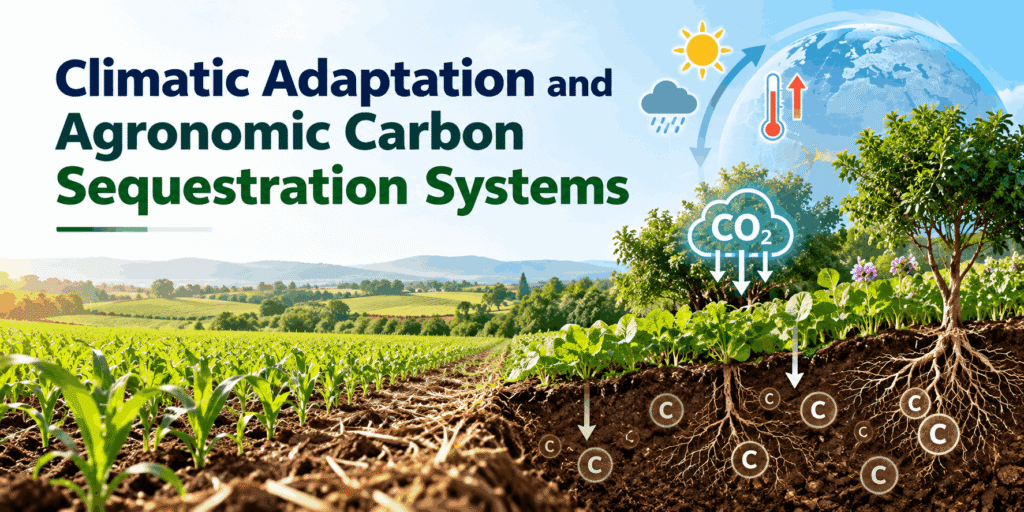
In agricultural ecology, plant breeding, and soil management, mitigating the impacts of climate change requires combining climate-resilient adaptation with mitigation technologies. For a UPSC Agriculture Optional candidate, this topic highlights how on-farm practices can transition from being sources of greenhouse gases to functional sinks for atmospheric carbon capture.
1. Tactical Strategies for Adapting to Climate Shocks
Adapting to rising thermal regimes and erratic monsoons requires modifying farm design, shifting crop choices, and optimizing water resource management:
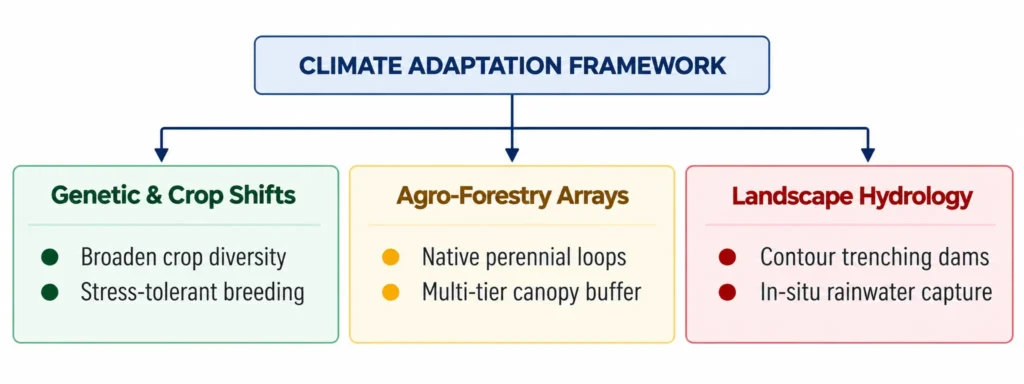
- Crop Diversification and Stress Breeding: Shifting away from risky monocultures to diverse cropping patterns. This shift is supported by breeding enduring crop varieties that possess high genetic tolerance to terminal heat, droughts, and salinity.
- Diversified Agro-Ecosystem Redesign: Integrating improved agro-forestry species and native perennial crops into the field layout. This structural configuration creates a multi-tier biological buffer that stabilizes the local microclimate and protects sensitive seasonal crops.
- Landscape Hydrology and Water Harvesting: Collecting and conserving rainwater using advanced in-situ techniques like contour trenching, check dams, and farm ponds. This infrastructure captures heavy monsoon runoff, slows soil erosion, and recharges unconfined aquifers.
- Enhancing Edaphic Water Holding Capacity: Expanding permanent forest covers and planting deep-rooted perennials and cover crops. These plants improve soil organic matter, which increases the water holding capacity (WHC) of the soil, allowing it to soak up intense rainfall and retain moisture during extended dry spells.
2. Soil Carbon Sequestration: Concepts and Agronomic Practices
Carbon sequestration is the process of capturing and storing atmospheric carbon dioxide (CO2) in long-term biological or geological sinks to reduce its concentration in the atmosphere and mitigate global climate change.
I. Crop Rotation and Cropping Intensity
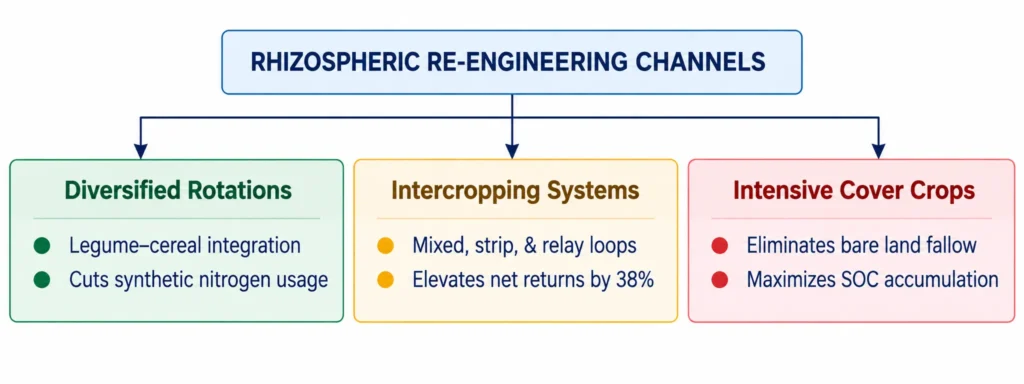
- Legume-Cereal Intercalation: Alternating deep-rooted non-legumes with high-biomass legumes improves soil carbon (C) sequestration.
- Reducing Synthetic Inputs: Growing legumes fixes atmospheric dinitrogen, significantly reducing the need for synthetic nitrogenous fertilizers. This reduction lowers the fossil fuel energy consumed during industrial chemical manufacturing (the Haber-Bosch process).
- Eliminating Bare Fallow: Increasing cropping intensity by minimizing bare land fallows in the rotation provides continuous plant residue inputs, maximizing organic carbon storage.
II. Intercropping Systems and Canopy Architecture
- Resource-Use Efficiency: Cultivating two or more crops simultaneously (via row, strip, mixed, or relay intercropping) optimizes the use of sunlight by balancing different plant architectures across the canopy field.
- The Strip-Cropping Dividend: Agronomic data shows that an integrated strip cropping system utilizing oats, corn, and soybeans on ridge-till rows can increase net economic returns by 38% compared to traditional monocultures. This mutual benefit maximizes both above-ground litterfall and underground root biomass, increasing the return of organic matter to the soil.
The El Niño Phenomenon: Ocean-Atmospheric Dynamics and Its Catastrophic Impact on Indian Agriculture – UPSC Agriculture Optional
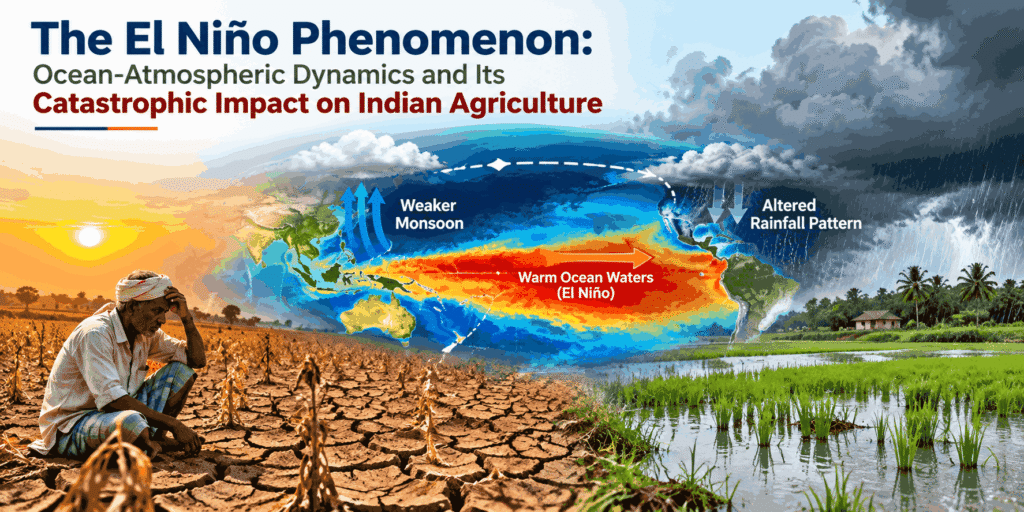
In agricultural meteorology and macro-agrarian economics, El Niño represents one of the most disruptive ocean-atmospheric variations in the global climate system. Because nearly 50% of India’s net cultivated area is strictly rain-fed, the country’s farming systems depend heavily on the timely onset, distribution, and volume of the Southwest Summer Monsoon.
An El Niño event disrupts this dependency, turning favorable weather into severe drought-like situations that compromise food security, cause yield failures, and drive food inflation.
1. Corrections and Structural Clarifications of the Ocean-Atmospheric Loop
- Scientific Correction on Monsoon Winds: The statement “El Nino facilitates the movement of monsoon winds from the sea to the Indian land without any significant diversion” is meteorologically incorrect. El Niño does the exact opposite: it weakens, suppresses, and diverts moisture-laden monsoon winds away from the Indian subcontinent, redirecting them toward the American coast.
- The Atmospheric Coupling (ENSO): El Niño is the oceanic component of the El Niño-Southern Oscillation (ENSO), where changes in sea surface temperatures (SST) in the tropical Pacific trigger immediate, corresponding changes in atmospheric surface pressure systems globally.
2. Step-by-Step Atmospheric and Spatial Dynamics of El Niño
The transition from a Normal Year to an El Niño Year involves a complete reversal of the Pacific thermal and pressure belts:
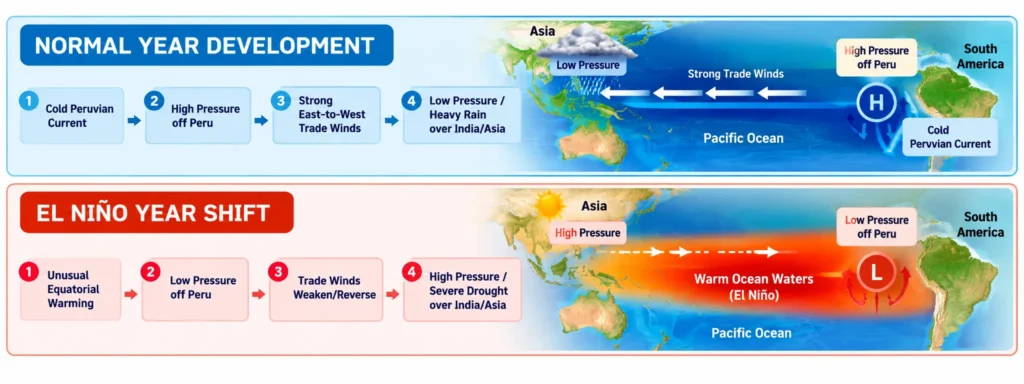
I. The Normal Year Equilibrium (Walker Circulation Baseline)
- Under normal conditions, the cold, northward-flowing Peruvian Current (Humboldt Current) maintains cool surface waters off the western coast of South America (Eastern Pacific).
- This creates a stable cold-water zone with high atmospheric surface pressure off the coast of Peru.
- Concurrently, strong East-to-West Equatorial Trade Winds push warm surface waters westward toward the Western Pacific (around Indonesia, Northern Australia, and South-East Asia), creating a deep, warm pool.
- This warm pool drives low atmospheric pressure over Asia, drawing moisture-laden winds from the Indian Ocean to power a strong Southwest Monsoon in India.
II. The El Niño Year Disruption
- Thermal Inversion: During an El Niño phase, the Equatorial Trade Winds weaken significantly or reverse direction. The warm surface pool flows back eastward across the Pacific, causing unusual warming of surface waters
off the coast of Peru. - Pressure Inversion: As the Eastern Pacific warms up, the air above it rises rapidly, causing surface air pressure above the Peruvian coast to drop. Conversely, the Western Pacific and the Indian Ocean cool down relatively, causing surface air pressure to rise over India, Indonesia, and Australia.
- Moisture Diversion: Winds naturally flow from high-pressure zones to low-pressure zones. Because the Peruvian coast presents a deep low-pressure system, the moisture-laden winds that should have traveled toward the Indian subcontinent are diverted eastward toward the South American coast.
- Precipitation Shifting: This moisture shift creates heavy cloud formations and torrential rains over the hyper-arid Peruvian deserts, robbing the Indian subcontinent of its vital monsoon rains. The larger the temperature and pressure difference across the Pacific, the more severe the monsoon shortfall in India.
3. Associated Hazards and Impacts on Indian Agriculture
The weakening of the Southwest Monsoon during El Niño seasons triggers a cascade of biophysical, economic, and social crises across India’s agricultural landscapes:
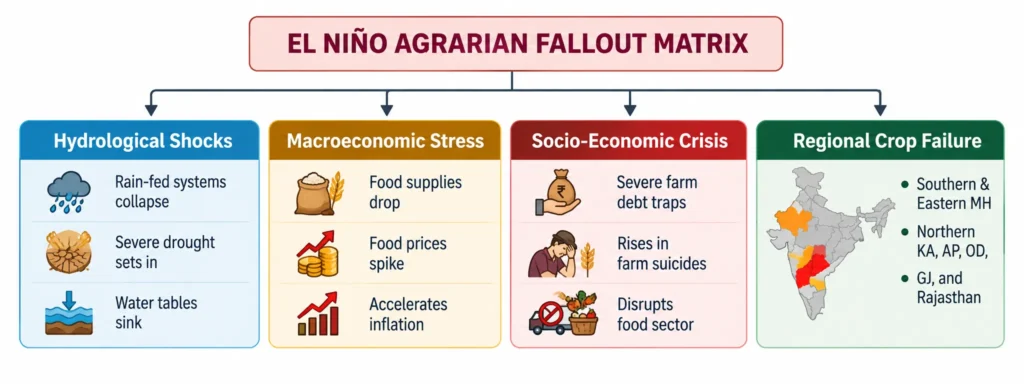
I. Hydrological Shocks to Rain-Fed Agronomy
- With approximately 50% of India’s agriculture remaining rain-fed, a sudden drop in monsoon rainfall leads to immediate drought situations.
- This depletion dries up local farm ponds, prevents ground-level water harvesting, stops groundwater recharge, and reduces the water available for protective crop irrigation.
II. Severe Reductions in Crop Yield
- Monsoon failures cause severe water shortages during critical growth stages (such as panicle initiation in rice or flowering in oilseeds), leading to below-average crop yields or complete crop failure.
- Vulnerable Agricultural Regions: The negative impacts concentrate heavily across India’s primary drought-prone belts: Southern and Eastern Maharashtra (Marathwada and Vidarbha), Northern Karnataka, Andhra Pradesh (Rayalaseema), Odisha, Gujarat, and Rajasthan.
III. The Rural Socio-Economic Debt Trap
- Smallholder farmers frequently take out operational bank or informal institutional loans to purchase high-value seeds and chemical inputs for the Kharif season.
- When El Niño-driven droughts cause complete crop failure, farmers lose their expected income and face severe debt traps. This financial distress and lack of alternative safety nets have historically driven high rates of farmer suicides across vulnerable dryland belts.
IV. Food Supply Shocks and Macroeconomic Inflation
- Widespread drops in food grain production cause immediate shortages in the domestic food supply.
- These supply shortfalls trigger a rapid spike in food prices (high food inflation) nationwide. This inflation reduces the real income of consumers and drives up input costs for downstream sectors, including the food processing industry.
Previous Year Question based on it
- “Global warming is due to human activities.” Justify the statement with appropriate examples. (15M, IFoS-2022)
- What is greenhouse effect? Write in detail about various greenhouse gases and their impact on crop production. (20M, CSE 2021)
- Explain EI-Nino effect. Give causes and its impact on Indian Agriculture. (10M, CSE 2020)
- What do you mean by carbon sequestration? Give the role of cropping systems for improving c-sequestration. (10M, CSE 2019)
- Describe Global warming and its impact on crop productivity (10M, 150W, CSE 2018)
- Explain green-house effect and sources of their emission. (10M, IFoS-2018)
- Describe Greenhouse effect and global warming (10M, 150W, CSE 2017)
- Greenhouse gases (GHG), their effects on crop production and possible remedial measures. (200W,10M, IFoS-2016)
- Explain El Nino effect, its causes and impact on Indian agriculture (15M, CSE 2015)
- What is greenhouse effect? Discuss the impact of global warming in agriculture. (10M, IFoS-2014)
- What are the major causes of global warming? (10M, 150W, CSE 2014)
- Short notes Greenhouse effect and global warming (10M,150W, CSE 2013)
- Enlist important greenhouse gases. How can agriculture affect climate change? Describe the importance of carbon sequestration. (40M, CSE 2011)
- Cyclonic storms in India (200W, CSE 1989)