

Natural Resources – UPSC Agriculture Optional
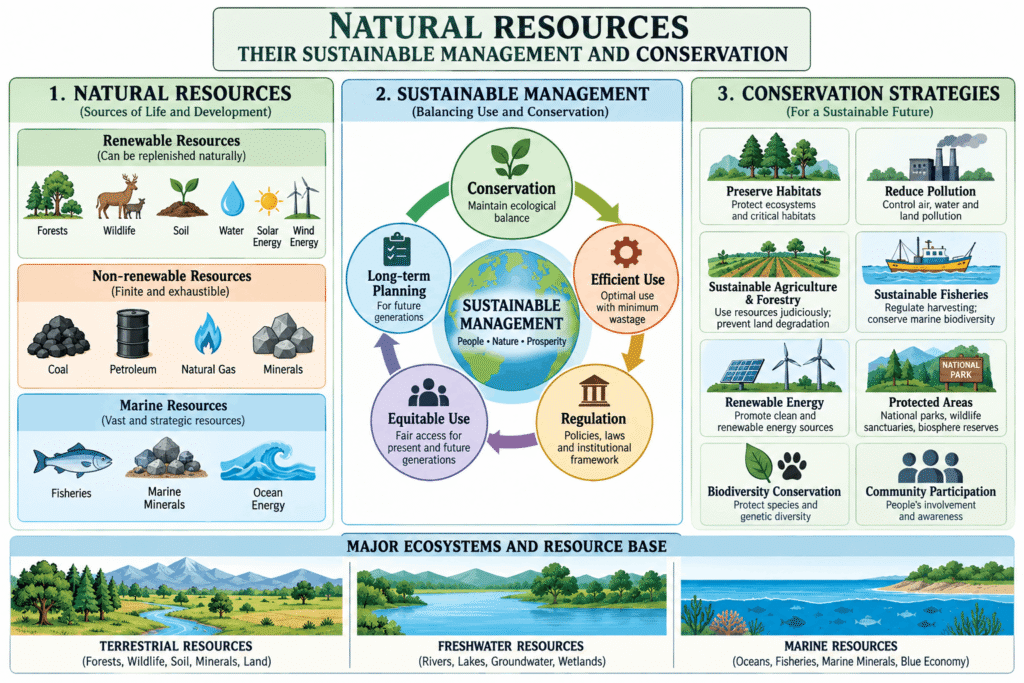
Natural resources are naturally occurring components, materials, and processes of the Earth that have actual or potential utility for human beings and support life, livelihoods, and economic activities.
In simple terms, any naturally occurring substance or environmental component that humans can use to satisfy their needs may be regarded as a natural resource.
Natural resources form the foundation of agriculture, industry, energy production, food security and human development.
Examples of Natural Resources
Natural resources include both biotic and abiotic components of the environment.
- Land and soil – support crop production, forestry and settlements.
- Water – surface water, groundwater, rivers, lakes and other freshwater resources.
- Air and atmosphere – provide gases essential for life and agricultural processes.
- Sunlight – provides the energy required for photosynthesis and drives many ecological processes.
- Minerals and rocks – include metals, stone, sand and other geological materials.
- Fossil fuels – coal, petroleum and natural gas provide energy and industrial raw materials.
- Vegetation – provides food, fodder, fibre, fuel, timber and medicinal products.
- Animals, birds and fish – provide food, fibre and other ecosystem and livelihood benefits.
Importance of Natural Resources
Natural resources provide the basic inputs required for human survival, agricultural production and economic development.
1. Food
Natural resources are the fundamental basis of food production.
- Plants provide cereals, pulses, fruits, vegetables, oilseeds and other food products.
- Animals and aquatic resources provide products such as milk, meat, eggs and fish.
- Soil, water, sunlight and biodiversity collectively support agricultural production.
2. Energy
Natural resources are major sources of energy.
- Coal, petroleum and natural gas are conventional fossil-fuel resources.
- Solar radiation provides renewable energy and is also the primary energy source for photosynthesis.
- Other renewable resources include wind, hydropower and biomass.
3. Industrial Raw Materials
Several natural resources serve as raw materials for manufacturing and construction.
For example:
- Minerals and metals machinery, infrastructure and industrial goods
- Timber construction, paper and furniture
- Cotton, wool and natural fibres textiles
- Petroleum and natural gas fuels and petrochemical products
4. Agricultural Production
Agriculture is directly dependent on natural resources.
Land + Soil + Water + Solar Energy + Biodiversity Agricultural Production
The quantity, quality and sustainable management of these resources determine the productivity, stability and long-term sustainability of farming systems.
Classification of Natural Resources
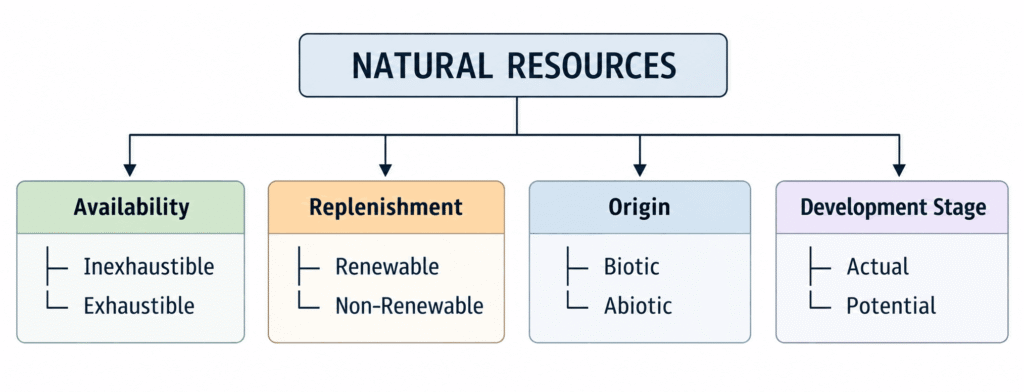
To design efficient conservation strategies, natural resources are classified based on their abundance, availability, and regenerative capacity:
A. Based on Abundance & Availability
- Inexhaustible Resources: Resources present in unlimited quantities that remain unaffected by human consumption (e.g., solar radiation, wind energy, tidal forces).
- Exhaustible Resources: Resources finite in supply that can be depleted, degraded, or completely spent through unscientific or excessive extraction.
B. Based on Replenishment Rate (Exhaustible)
- Renewable Resources: Dynamic resources that can naturally regenerate, reproduce, or recycle over a short biological or hydrological timescale if extraction does not exceed their carrying capacity (e.g., forests, groundwater, wild fauna).
- Non-Renewable Resources: Fixed-stock resources whose geological formation takes millions of years. Once consumed, they are gone forever on a human timescale (e.g., coal, petroleum, iron ore).
C. Based on Origin
- Biotic Resources: Organic substances derived from the living sphere or biosphere (e.g., timber, marine organisms, fossil fuels like petroleum and coal which originate from decayed organic matter).
- Abiotic Resources: Inorganic materials derived from non-living components of the earth (e.g., land, clean air, fresh water, heavy metals).
D. Based on Development Stage
- Actual Resources: Formally surveyed, qualitatively and quantitatively assessed, and actively utilized using current technology (e.g., Mumbai High oil fields).
- Potential Resources: Resources known to exist in a specific geographic region but awaiting advanced technology or economic viability to be fully tapped (e.g., deep geothermal potential or wind energy capacity in Rajasthan).
Sustainable Management and Conservation Principles
Unregulated agricultural expansion has triggered severe resource degradation, characterized by soil erosion, groundwater depletion, and loss of biodiversity. Sustainable resource management requires implementing ecologically sound practices that preserve the resource base for future generations.
Intensive Agricultural Practices & Resource Sustainability
|
Agricultural Practice |
Targeted Natural Resource |
Core Ecological Impact & Degradation Mechanism |
|---|---|---|
|
Monoculture Cropping |
Soil Health & Nutrients |
Strips specific, uniform nutrients from the topsoil; breaks down soil aggregate structures; eliminates ecological niches, drastically reducing agricultural biodiversity. |
|
Flood/Over-Irrigation |
Land & Groundwater |
Triggers widespread waterlogging. Capillary action draws deep underground salts to the surface, causing massive soil salinisation (e.g., Green Revolution pockets of Punjab and Haryana). |
|
Chemical Abuse (NPK + Pesticides) |
Soil Ecosystems & Water |
Kills beneficial soil microfauna (earthworms, nitrogen-fixing bacteria); alters soil pH; chemical runoff into surface waters causes hyper-nutrient enrichment, driving severe eutrophication. |
|
Groundwater Mining |
Hydrological Aquifers |
Unregulated extraction via deep tube wells for water-heavy crops (like paddy or sugarcane in arid zones) drops water tables rapidly, leading to localized land subsidence. |
|
Stubble Burning |
Air Quality & Soil Carbon |
Destroys valuable organic matter (humus) on the soil surface; obliterates beneficial surface microbial colonies; releases heavy loads of particulate matter (PM2.5) and greenhouse gases. |
|
Slash-and-Burn (Jhum) |
Forests & Topsoil |
Shortened fallow cycles prevent forest regeneration, accelerating severe wind and water topsoil erosion and fragmenting critical wildlife habitats. |
Actionable Blueprint for Long-Term Resource Conservation
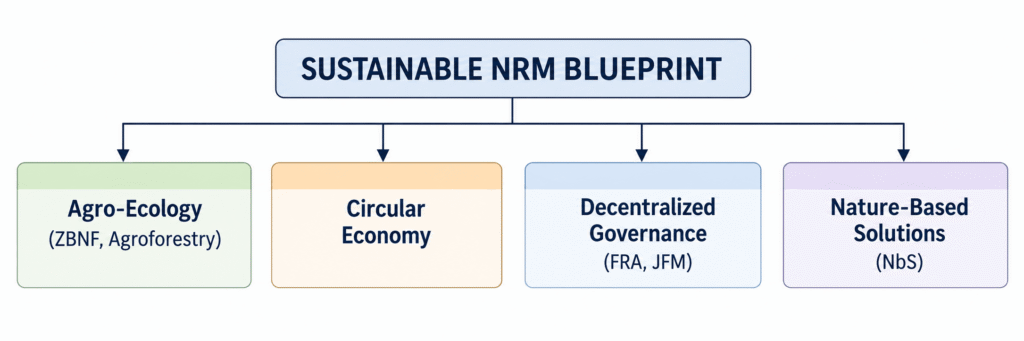
To protect resources for the long term, policies must shift from exploitative extraction to a model of restorative stewardship.
A. Restorative Agriculture & Soil Management
- Agro-Ecological Shifts: Mass adoption of Zero Budget Natural Farming (ZBNF), organic crop rotations, and multi-tier agroforestry systems to naturally replenish soil organic carbon.
- Precision Farming: Using soil health cards, laser land-leveling, and targeted nutrient delivery to systematically eliminate chemical fertilizer waste.
B. Hydrological Conservation & Water Security
- Integrated Water Resources Management (IWRM): Managing entire river basins as unified hydrological units rather than separate political territories.
- Micro-Irrigation mandating: Substituting resource-heavy flood irrigation with advanced drip and micro-sprinkler networks, reinforced by mandatory decentralized rainwater harvesting.
C. Industrial Transformation & Circular Economy
- The 3R Operational Loop: Mandating a Reduce, Reuse, Recycle closed-loop lifecycle across manufacturing sectors to slash primary raw material extraction.
- Extended Producer Responsibility (EPR): Legally binding industries to manage the entire post-consumer lifecycle of their products (e.g., electronic and plastic waste).
D. Decentralized, Community-Led Governance
- Empowering Local Institutions: Strengthening localized institutional models like Joint Forest Management (JFM) committees and enforcing the Forest Rights Act (FRA). This ensures indigenous communities are the primary guardians of local biodiversity.
- Co-Management Models: Pairing modern conservation science with traditional ecological knowledge to manage vulnerable ecological buffer zones.
E. Nature-Based Solutions (NbS)
- Green Infrastructure Development: Restoring coastal mangrove belts to absorb cyclonic impacts, and conserving urban wetlands to serve as natural stormwater sponges.
Policy Frameworks & Global Targets
- Sustainable Development Goals (SDGs):
- SDG 6: Clean Water and Sanitation
SDG 12: Responsible Consumption and Production
SDG 15: Life on Land (combating land degradation and biodiversity loss)
- SDG 6: Clean Water and Sanitation
- Global Biodiversity Framework (GBF): The “30×30” Target, which aims to effectively conserve 30% of the world’s terrestrial, inland water, coastal, and marine areas by 2030.
- Indian Legislative Anchors: Use these acts as legal citations in your conclusions:
- Biological Diversity Act, 2002 (Decentralized conservation via Biodiversity Management Committees)
- Environment (Protection) Act, 1986 (Umbrella legislation for eco-sensitive zones)
- National Water Policy (Advocating for basin-wide management)
Previous Year Question based on it
- Give an account of agricultural practices affecting sustainability of natural resources. (8M, IFoS-2023)
- Discuss the influences of human beings and natural resources on ecology and nature. (8M, IFoS-2022)
- Classify various natural resources. Discuss the steps for long term conservation of natural resources. (20M, CSE 2022)
- The major ways for sustainable management of natural resources. (10M, 150W, CSE 2021)
- Short notes Conservation of natural resources (20M, 200W, CSE 2004)
- Short critical notes Natural Resource Management (20M, 200W, CSE 2000)