

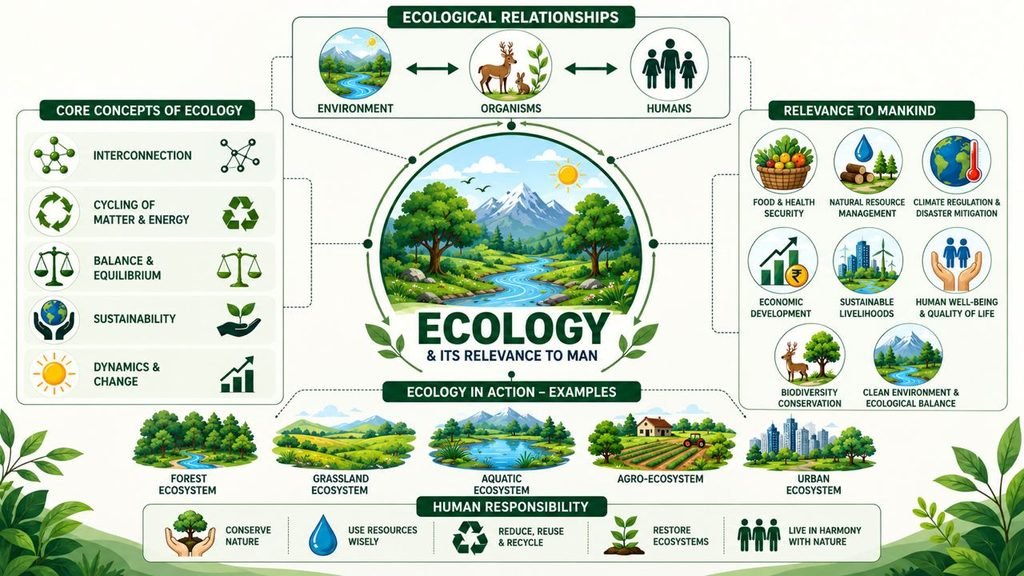
What is Environment?
The environment refers to the sum total of all the living (biotic) and non-living (abiotic) conditions that surround an organism and influence its growth, development, survival, reproduction, and distribution. In simple words, the environment is the immediate surroundings in which an organism lives, interacts, and carries out its life processes.
The environment includes both natural and human-made components. It is not limited to physical surroundings such as air, water, and soil; it also includes living organisms and the interactions that occur among them.
What is Ecology?
Ecology is the branch of biological science that deals with the interrelationships between living organisms and their environment. It studies how organisms interact with one another as well as with the physical and chemical components of their surroundings.
In simple terms, ecology explains how organisms live, interact, and respond to changes in their environment.
The term ecology is derived from the Greek words “Oikos”, meaning home or dwelling, and “Logos”, meaning study. Thus, ecology can broadly be understood as the study of organisms in their natural home or environment.
Importance of Ecology in Agriculture
Understanding ecology helps in developing sustainable and environmentally sound agricultural practices. It provides the basis for concepts such as integrated pest management, organic farming, biodiversity conservation, nutrient cycling, agroforestry, and sustainable crop production.
What is an Ecosystem?
An ecosystem is the structural and functional unit of ecology in which living organisms interact with one another and with the non-living components of their environment. It consists of a biotic community along with abiotic components, which are interconnected through the flow of energy and cycling of nutrients.
In simple words, an ecosystem is a functional system where plants, animals, microorganisms, soil, water, air, sunlight, and other environmental factors interact with each other.
Ecology: Definition, History and Important Facts
Ecology is the scientific study of the interactions among living organisms and between organisms and their abiotic environment. It examines how plants, animals, microorganisms, and other living organisms interact with one another and with factors such as temperature, water, air, soil, light, humidity, and nutrients.
In simple terms, ecology helps us understand how organisms live together, how they depend on their surroundings, and how changes in one component of the environment affect other components.
For example, in an agricultural field, a crop interacts with soil, water, sunlight, temperature, microorganisms, insects, weeds, and other organisms. These interactions determine crop growth, productivity, nutrient availability, and ecological balance.
Important Facts About Ecology
|
Aspect |
Important Fact |
|---|---|
|
Meaning of Ecology |
Study of relationships between organisms and their environment |
|
Origin of word |
Greek: Oikos + Logos |
|
Term coined by |
Ernst Haeckel |
|
Year |
1866 |
|
Father of Modern Ecology |
Eugene P. Odum |
|
Father of Indian Ecology |
Ramdeo Misra |
|
Major unit studied in ecology |
Ecosystem |
|
Major processes |
Energy flow and nutrient cycling |
Branches of Ecology
Ecology can be broadly divided into two major branches: Autecology and Synecology. This classification is based on whether the focus is on an individual species or on a community of different species.
1. Autecology
Autecology is the branch of ecology that deals with the study of an individual organism or a particular species in relation to its environment.
It focuses on the adaptations, distribution, behaviour, life processes, and responses of a species to various environmental factors such as temperature, water, light, soil, humidity, and nutrients.
Example of Autecology
The study of how a wheat plant responds to temperature, water availability, soil type, photoperiod, and nutrient availability is an example of autecology.
Similarly, studying the adaptations of a cactus to drought conditions or the response of a crop to salinity stress comes under autecology.
2. Synecology
Synecology is the branch of ecology that deals with the study of groups or communities of different species and their relationships with one another and with their surrounding environment.
It focuses on the structure, composition, distribution, and functioning of ecological communities and ecosystems.
Example of Synecology
A study of an agricultural field as a community, including crops, weeds, insects, birds, earthworms, microorganisms, soil, water, and climatic factors, is an example of synecology.
For instance, studying the relationship between crops, weeds, insect pests, natural enemies, and soil microorganisms in a crop field helps us understand the functioning of the agricultural community.
Some Important Concepts of Ecology
Ecology is organized into different levels of biological organization, known as the ecological hierarchy. As we move from one level to the next, there is generally an increase in size, organization, interactions, and complexity.
The ecological hierarchy can be represented as:
Organism → Species/Population → Biotic Community → Ecosystem → Biome → Biosphere
1. Organism
An organism is the smallest and basic unit of ecology. It refers to an individual living entity capable of carrying out essential life processes such as growth, respiration, nutrition, reproduction, and response to the environment.
Organisms may be unicellular (single-celled), such as bacteria and certain protozoans, or multicellular, such as plants, animals, and humans. Every organism interacts continuously with its surrounding environment and responds to various biotic and abiotic factors.
2. Species or Population
A species is a group of organisms that share common characteristics and can generally interbreed with one another to produce fertile offspring. Members of the same species living within a particular geographical area form a population.
Thus, a population represents organisms of the same species occupying a specific area at a given time.
For example, all the wheat plants growing in a particular agricultural field can be considered a population of wheat.
Endemic Species
Endemic species are species that are naturally restricted to a particular geographical area. Their distribution may be limited to a specific island, mountain range, country, or ecological region.
For example, kangaroos are native to Australia. In India, examples of species with restricted geographical distributions include the Nilgiri tahr of the Western Ghats and the lion-tailed macaque of the Western Ghats.
Keystone Species
A keystone species is a species whose presence or activities have a major influence on the structure, stability, and functioning of a biological community, even if the species itself is not very abundant.
Predators can act as keystone species by controlling the population of herbivores or other prey species. For example, large predators such as lions can influence prey populations and thereby affect vegetation and other components of the ecosystem.
A well-known example is the sea otter, whose predation on sea urchins helps maintain kelp forest ecosystems.
Critical Link Species
Critical link species are organisms that play an important role in connecting different species or ecological processes. Their activities may be essential for the survival, reproduction, or functioning of other organisms.
For example, bees and other pollinators act as critical links between flowering plants and their reproductive processes. By transferring pollen from one flower to another, they facilitate pollination and seed production.
Similarly, organisms involved in symbiotic relationships can be important ecological links because the interaction may provide essential benefits to the associated organisms.
What is a Community in Ecology?
A community or biotic community refers to a group of populations belonging to different species that live together in a particular geographical area and interact with one another.
It includes different types of plants, animals, microorganisms, and other living organisms. These organisms are interconnected through various ecological interactions such as competition, predation, parasitism, mutualism, and commensalism.
Unlike a population, which consists of members of the same species, a community consists of populations of different species living and interacting in the same area.
What is an Ecosystem?
An ecosystem is the functional unit of ecology in which a community of living organisms interacts with the physical and chemical environment surrounding it.
An ecosystem consists of two major components:
Biotic components + Abiotic components
These components are continuously interconnected through energy flow and nutrient cycling. The functioning of an ecosystem depends on the interaction between living organisms and non-living environmental factors.
For example, an agricultural field functions as an ecosystem where crops, weeds, insects, microorganisms, soil, water, air, sunlight, and nutrients interact with one another.
Major Component Sub-components Examples:
Biotic Components Producers Green plants, crops, algae Consumers Herbivores, carnivores, omnivores, insects, birds, livestock, humans Decomposers Bacteria, fungi Abiotic Components Climatic/physical factors Temperature, rainfall, water, air, light, humidity Edaphic factors Soil, soil moisture, soil pH, minerals Inorganic substances Nitrogen, phosphorus, sulphur, carbon, water, oxygen, carbon dioxide Organic substances Carbohydrates, proteins, lipids, humus, and other organic matter.
Components of an Ecosystem
|
Major Component |
Sub-components |
Examples |
|---|---|---|
|
Biotic Components |
Producers |
Green plants, crops, algae |
|
Consumers |
Herbivores, carnivores, omnivores, insects, etc. |
|
|
Decomposers |
Bacteria, fungi |
|
|
Abiotic Components |
Climatic/physical factors |
Temperature, rainfall, water, air, light, humidity |
|
Edaphic factors |
Soil, soil moisture, soil pH, minerals |
|
|
Inorganic substances |
Nitrogen, phosphorus, sulphur, carbon, water |
|
|
Organic substances |
Carbohydrates, proteins, lipids, humus, and amino acids |
1. Biotic Components
Biotic components are the living organisms present in an ecosystem. They can be broadly classified into producers, consumers, and decomposers.
Producers
Producers are organisms capable of producing their own food, primarily through photosynthesis. Green plants form the major producers in terrestrial ecosystems.
In agriculture, rice, wheat, maize, pulses, vegetables, and other crops act as producers.
Consumers
Consumers cannot produce their own food and obtain energy by feeding on other organisms. They include herbivores, carnivores, omnivores, and other organisms.
Examples in an agricultural ecosystem include:
- Insect pests feeding on crops.
- Birds feeding on insects or grains.
- Livestock feeding on plants.
- Humans consuming crops and livestock products.
Decomposers
Decomposers are mainly bacteria and fungi that break down dead plants, animals, and organic matter into simpler substances.
They play a crucial role in decomposition and nutrient recycling, thereby returning nutrients to the soil for uptake by plants.
For agriculture, decomposers are particularly important for maintaining soil fertility and nutrient availability.
2. Abiotic Components
Abiotic components are the non-living physical and chemical factors of an ecosystem. They determine the environmental conditions under which organisms survive and grow.
Climatic and Physical Factors
These include:
- Temperature
- Light
- Water
- Air
- Rainfall
- Humidity
- Soil
These factors have a direct influence on crop growth, development, distribution, and productivity.
Inorganic Substances
Important inorganic substances include:
- Nitrogen
- Phosphorus
- Sulphur
- Carbon
- Oxygen
- Carbon dioxide
- Water
- Mineral nutrients
These substances participate in various biogeochemical cycles and are essential for plant and microbial growth.
Organic Substances
Organic substances present in ecosystems include:
- Carbohydrates
- Proteins
- Lipids
- Humus
- Other organic compounds
These substances are important components of living organisms and organic matter and play an important role in energy transfer and nutrient cycling.
Abiotic Factors: Temperature
Temperature is one of the most important abiotic or ecological factors influencing the survival, growth, distribution, and productivity of organisms. It affects almost all biological processes and determines the ability of organisms to survive in a particular environment.
Environmental temperature varies greatly across the Earth, ranging from sub-zero temperatures in polar regions to above 50°C in some tropical deserts. In extreme environments such as hot springs and deep-sea hydrothermal vents, temperatures may exceed 100°C in certain locations.
Effect of Temperature on Organisms
Temperature has a major influence on the kinetics of enzymes and, consequently, on the metabolic and physiological activities of organisms.
It affects processes such as:
- Enzyme activity and metabolic rate.
- Photosynthesis and respiration.
- Transpiration and water loss.
- Germination and seed development.
- Growth and reproduction.
- Flowering and fruit development.
- Distribution and survival of organisms.
For example, in agriculture, temperature strongly influences crop germination, vegetative growth, flowering, maturity, and final yield. Each crop has a specific temperature range within which it grows optimally.
Temperature and Crop Growth
Different crops have different temperature requirements.
- Wheat generally performs better under relatively cool conditions during much of its growing period.
- Rice is generally adapted to warmer conditions.
- Excessively high temperatures can cause heat stress, affecting flowering, pollen viability, grain filling, and yield.
- Very low temperatures can cause chilling or frost injury in susceptible crops.
Thus, temperature is an important factor in determining the geographical distribution and growing season of crops.
Classification Based on Temperature Tolerance
Organisms differ in their ability to tolerate fluctuations in temperature. Based on their tolerance range, they can broadly be classified as eurythermal and stenothermal organisms.
Eurythermal Organisms
Eurythermal organisms can tolerate a relatively wide range of environmental temperatures. They are better able to withstand temperature fluctuations.
Stenothermal Organisms
Stenothermal organisms can survive only within a relatively narrow temperature range. Even small deviations from their preferred temperature range may adversely affect their physiological functions.
Abiotic Factors: Water
Water is one of the most important abiotic factors and is essential for the survival, growth, metabolism, and reproduction of all living organisms. Life is believed to have originated in aquatic environments, and water continues to serve as the primary medium for numerous biological and biochemical processes.
Organisms living in aquatic environments require specific physiological, structural, and behavioural adaptations to survive under different water conditions.
For example, aquatic plants may have adaptations that help them remain buoyant, while aquatic animals may possess specialized structures for respiration, osmoregulation, and movement in water.
Importance of Water for Organisms
Water plays several essential roles in living organisms:
- Acts as a medium for biochemical reactions.
- Helps in the transport of nutrients and metabolic products.
- Regulates body temperature.
- Maintains cell structure and turgidity in plants.Facilitates photosynthesis in plants.
- Supports growth, reproduction, and other physiological processes.
In agriculture, water availability is a major determinant of crop growth and productivity. Both water deficiency and excess water can adversely affect crops.
Water Quality as an Ecological Factor
The ecological importance of water depends not only on its availability but also on its quality. Several physical and chemical characteristics determine the suitability of water for organisms.
Important factors include:
- pH
- Temperature
- Dissolved oxygen
- Salinity
- Mineral content
- Chemical composition
- Nutrient concentration
- Presence of pollutants
Changes in these factors can significantly affect the organisms inhabiting a particular aquatic environment.
Salinity of Water
Salinity refers to the concentration of dissolved salts in water and is commonly expressed in parts per thousand (ppt or ‰).
Classification Based on Salinity Tolerance
Aquatic organisms differ in their ability to tolerate changes in salinity. Based on their salinity tolerance, they are broadly classified as euryhaline and stenohaline organisms.
Euryhaline Organisms
Euryhaline organisms are capable of tolerating a wide range of salinity. They are commonly found in environments where salinity changes considerably, such as estuaries, where freshwater mixes with seawater.
For example, some species of salmon and eels can tolerate changes between freshwater and marine environments during different stages of their life cycle.
Stenohaline Organisms
Stenohaline organisms have a narrow tolerance range for salinity. Significant changes in salinity may disturb their osmotic balance and physiological functioning.
Many organisms adapted specifically to freshwater or marine environments are relatively stenohaline.
Importance of Water in Agriculture
Water is one of the most critical factors determining agricultural productivity. Crops require adequate water for processes such as germination, nutrient uptake, photosynthesis, cell expansion, and transpiration.
However, both extremes can be harmful:
- Water deficit → Drought stress → Reduced growth and yield
- Excess water → Waterlogging → Reduced soil oxygen → Root stress
Similarly, excessive salts in irrigation water or soil can create salinity stress, reducing the ability of plants to absorb water and nutrients.
Therefore, understanding water availability and quality is essential for irrigation management, crop selection, soil management, and sustainable agriculture.
Abiotic Factors: Light
Light is one of the most important abiotic factors in an ecosystem. Sunlight is the primary source of energy for almost all ecosystems and drives the process of photosynthesis.
Green plants and other photosynthetic organisms, known as producers, capture solar energy and convert it into chemical energy in the form of organic food. This stored energy is subsequently transferred to consumers and decomposers through food chains and food webs.
Sunlight → Photosynthesis → Chemical energy → Food → Energy flow
Importance of Light in Ecosystems
Light influences several important physiological and ecological processes, including:
- Photosynthesis and primary productivity
- Growth and development of plants
- Seed germination and seedling growth
- Flowering and reproduction
- Daily biological rhythms
- Seasonal activities and distribution of organisms
The availability of light varies with latitude, season, altitude, cloud cover, vegetation, and water depth. These variations influence the distribution and productivity of organisms.
Spectral Quality of Light
The ecological effect of light depends not only on its intensity and duration but also on its spectral quality, i.e., the different wavelengths of light.
Different wavelengths have different effects on organisms. The visible portion of sunlight is particularly important for photosynthesis, while excessive exposure to ultraviolet (UV) radiation can be harmful to many organisms and may cause cellular and genetic damage.
Thus, the quality, intensity, and duration of light can influence the growth and development of organisms.
Photoperiodism
Light also plays an important role in the flowering of plants.
Photoperiodism is the response of plants to the relative duration of day and night, particularly in relation to flowering.
Many plants require a specific day-length condition, known as the critical photoperiod, to initiate flowering.
Importance of Photoperiodism in Agriculture
Photoperiodism has considerable importance in agriculture and crop production because flowering time affects crop maturity, adaptation, and productivity.
For example, knowledge of photoperiodic responses helps in:
- Selecting suitable crop varieties for different regions.
- Understanding the flowering behaviour of crops.
- Determining suitable sowing periods.
- Developing varieties adapted to different latitudes.
- Managing crop maturity and production.
Light and Agriculture
Light is particularly important for crops because it affects photosynthesis, biomass production, flowering, and yield.
For example, insufficient light can reduce photosynthetic activity and crop growth, while excessive radiation combined with high temperature may contribute to heat and radiation stress.
Therefore, light is an important factor considered in crop ecology, agro-climatology, and crop production.
Soil as an Abiotic Factor
“Land, then, is not merely soil; it is a fountain of energy flowing through a circuit of soils, plants, and animals.” — Aldo Leopold
Soil is one of the most important abiotic factors in agriculture and terrestrial ecosystems. Almost everything we eat can be traced directly or indirectly to soil. It provides plants with physical support, water and essential nutrients required for growth.
Far from being lifeless dirt, fertile soil is a dynamic system teeming with organisms such as earthworms, arthropods, bacteria, fungi and other microorganisms. The decaying and fully decomposed remains of plants and animals, along with their excreta, contribute to soil organic matter.
The mineral fraction of soil mainly consists of sand, silt and clay. Their relative proportions determine soil texture and influence water retention, drainage, aeration and nutrient availability.
Soil Organic Matter
Soil organic matter is a key component of healthy and fertile soil. It improves the physical, chemical and biological properties of soil.
- Improves soil structure and aggregation.
- Increases water-holding capacity.
- Helps retain and supply nutrients to plants.
- Supports microbial activity and nutrient cycling.
- Improves soil aeration and root development.
- Acts as an important reservoir of soil organic carbon.
- Improves soil resilience during drought and water stress.
Organic matter helps soil retain water and nutrients, making them more accessible to plant roots. Hence, maintaining adequate organic matter is particularly important for soil fertility, sustainable agriculture and drought resilience.
Soil Biodiversity
Healthy soil contains a diverse community of organisms, including:
Earthworms → Arthropods → Bacteria → Fungi → Other soil microorganisms
These organisms contribute to decomposition, nutrient cycling, soil aggregation and maintenance of soil fertility. Thus, soil health depends not only on its mineral composition but also on its organic matter and biological activity.
Freshwater as an Abiotic Factor – Agriculture Optional
“We know the value of water when the well runs dry.” — Benjamin Franklin
Freshwater is a critical abiotic factor in agriculture. Growing crops and raising livestock depend on a reliable supply of freshwater. Water is essential for plant growth, nutrient transport, photosynthesis, livestock production and agricultural productivity.
Availability of Freshwater
Although water covers most of the Earth’s surface, freshwater is a scarce resource. Only about 2.5% of the Earth’s water is freshwater, while the remaining water is saline.
A large majority of freshwater is stored in gliers, ice caps and groundwater, much of which is difficult or unavailable for immediate human use. Only a very small fraction of the Earth’s total water is readily accessible for human and agricultural needs.
Global Water Distribution
Earth’s water → 97.5% saline water + 2.5% freshwater
Freshwater → Glaciers & ice caps + Groundwater + Surface water
The limited availability of accessible freshwater makes its efficient management essential for sustainable agriculture.
Freshwater Sources for Agriculture
Where rainfall is inadequate or unreliable, farmers depend on different sources of freshwater for irrigation and livestock production.
Major sources include:
- Rivers
- Lakes
- Reservoirs
- Wetlands
- Groundwater
Irrigation therefore plays an important role in maintaining agricultural production in regions where rainfall alone is insufficient.
Freshwater and Irrigated Agriculture
Approximately 17% of global agricultural land is irrigated, while agriculture accounts for the majority of global freshwater withdrawals. Irrigation is particularly important for increasing and stabilising crop production in water-limited regions.
However, excessive or inefficient irrigation can lead to:
- Groundwater depletion.
- Waterlogging.
- Soil salinity.
- Falling water tables.
- Increased energy costs for pumping.
- Long-term decline in agricultural sustainability.
Groundwater Depletion
In many parts of the world, freshwater is being extracted faster than natural processes can replenish it.
The High Plains Aquifer in the United States provides an important example. The aquifer lies beneath parts of eight U.S. states and has experienced significant depletion in some areas, largely due to groundwater extraction for agriculture.
Water-intensive crops such as corn, which is widely used for livestock feed and biofuels, have contributed to high irrigation demand in some regions.
Continued groundwater depletion can result in:
Excessive pumping → Falling groundwater table → Declining well yields → Higher pumping costs → Reduced agricultural sustainability
Groundwater recharge may occur very slowly in some aquifers, meaning that excessive extraction can create a long-term water security challenge.
Importance of Freshwater in Agriculture
Freshwater supports agriculture through:
- Irrigation and crop production.
- Nutrient transport within plants.
- Photosynthesis and plant growth.
- Livestock drinking water and animal production.
- Aquaculture and other agricultural activities.
- Maintenance of soil moisture and ecosystem functions.
Therefore, freshwater availability is closely linked with food security and agricultural productivity.
Responses to Abiotic Factors
Organisms are continuously exposed to changes in environmental factors such as temperature, water availability, salinity, humidity, light and oxygen concentration. These abiotic factors can create stressful conditions that may affect the survival, growth and reproduction of organisms.
To maintain homeostasis and survive under adverse environmental conditions, organisms adopt different strategies such as regulation, conformity, migration, suspension and adaptation.
1. Regulation
Regulation is the ability of an organism to maintain a relatively stable internal environment despite changes in external environmental conditions.
Many mammals and birds, and a few other vertebrates and invertebrates, are capable of regulating their internal temperature through physiological and behavioural mechanisms.
For example:
- Mammals maintain a relatively constant body temperature through mechanisms such as sweating, shivering and changes in metabolic activity.
- Birds maintain their body temperature through metabolic heat production and behavioural mechanisms.
- Some organisms regulate their internal osmotic concentration through mechanisms of osmoregulation.
Organisms that maintain a relatively constant body temperature are called homeotherms, while organisms that generate substantial metabolic heat are generally described as endotherms.
2. Conformity
In conformity, an organism’s internal physiological conditions change with changes in the external environment.
Many plants and animals are unable to maintain a completely constant internal temperature or osmotic concentration when environmental conditions change. Such organisms are commonly called conformers.
Examples:
- Body temperature of many ectothermic animals varies with environmental temperature.
- Osmotic concentration in many aquatic organisms changes according to the surrounding water.
Most plants, fungi and many invertebrates largely depend on environmental conditions and show conformity for several physiological parameters.
Ectotherms
Ectotherms depend mainly on external sources of heat to regulate their body temperature. They may nevertheless use behavioural mechanisms such as basking, seeking shade or changing their position to influence body temperature.
3. Migration
Migration is the temporary movement of organisms from an unfavourable or stressful environment to a more favourable region.
The organism returns to its original habitat when favourable conditions are restored.
Significance of Migration
Migration helps organisms:
- Avoid extreme climatic conditions
- Find adequate food and water
- Escape unfavourable temperatures
- Improve chances of survival and reproduction
4. Suspension
When environmental conditions become extremely unfavourable, some organisms temporarily suspend their metabolic activities or enter a state of dormancy.
This enables them to survive periods of extreme temperature, drought, food scarcity or other environmental stresses.
Important Examples
- Hibernation: A state of reduced metabolic activity during periods of extreme cold or winter.
- Aestivation: A state of dormancy during periods of extreme heat or dryness.
- Diapause: A period of suspended development or physiological inactivity seen in several organisms, particularly insects and some zooplankton, during unfavourable environmental conditions.
- Thick-walled spores: Lower plants, fungi and bacteria can produce resistant structures or spores that help them survive adverse environmental conditions.
- Dormancy in plants: Many higher plants survive unfavourable periods by entering a state of dormancy, during which metabolic activity and growth are reduced.
5. Adaptation
Adaptation refers to morphological, physiological and behavioural characteristics that enable an organism to survive and reproduce successfully in its habitat.
Adaptations develop over generations through evolutionary processes and increase the fitness of organisms under particular environmental conditions.
Examples of Adaptations to Abiotic Stress
A. Kangaroo Rat – Adaptation to Desert Conditions
The kangaroo rat is highly adapted to arid environments where water is scarce.
It meets much of its water requirement through:
- Metabolic water produced during the oxidation of stored fats.
- Production of highly concentrated urine, which minimizes water loss.
- Efficient water conservation mechanisms.
B. Desert Plants – Adaptation to Water Scarcity
Desert plants, particularly xerophytes, show several adaptations to reduce water loss and survive prolonged drought.
Important adaptations include:
- Thick waxy cuticle to reduce transpiration.
- Sunken stomata to reduce water loss.
- Leaves reduced to spines in plants such as cactus.
- Green stems capable of carrying out photosynthesis.
- Extensive root systems for efficient water absorption.
- CAM (Crassulacean Acid Metabolism) photosynthesis in many desert plants.
CAM Adaptation
In CAM plants:
- Stomata generally open during the night.
- Carbon dioxide is fixed and stored as organic acids.
- During the day, stomata remain closed, reducing water loss through transpiration.
- Stored carbon dioxide is subsequently utilized for photosynthesis.
C. Allen’s Rule
Allen’s Rule states that in closely related warm-blooded animals, populations living in colder climates tend to have shorter appendages, such as ears, tails and limbs, compared with populations living in warmer climates.
Shorter appendages reduce the surface area available for heat loss.
Example: Arctic mammals generally have relatively smaller ears and shorter extremities than their tropical relatives.
D. Blubber in Seals
Seals living in cold environments possess a thick layer of subcutaneous fat called blubber.
Blubber:
- Provides thermal insulation.
- Reduces heat loss to cold water.
- Acts as an energy reserve.
- Helps the animal survive in extremely cold environments.
E. Human Adaptation to High Altitude
People living at high altitudes experience low atmospheric oxygen availability.
Long-term high-altitude populations show physiological adaptations that improve oxygen transport and utilization.
Important adaptations include:
- Increased efficiency of oxygen transport.
- Changes in haemoglobin concentration and oxygen affinity.
- Increased red blood cell production in some high-altitude populations.
- Physiological adjustments that improve oxygen delivery to tissues.
Himalayan Populations
Traditional high-altitude populations in the Himalayas show adaptations that help them cope with hypobaric hypoxia—the reduced partial pressure of oxygen at high altitude.
6. Species Interactions
Organisms do not exist in isolation. They continuously interact with other organisms in their ecosystem.
These interactions may be beneficial, harmful or neutral for the participating species.
Important interspecific interactions include:
- Commensalism
- Amensalism
- Mutualism
- Competition
- Predation
- Parasitism
A. Commensalism (+/0)
Commensalism is an interaction in which one species benefits while the other is neither significantly benefited nor harmed.
Examples
- Cattle egrets and cattle: Cattle egrets benefit by feeding on insects disturbed by grazing cattle, while cattle are generally neither significantly benefited nor harmed.
- Epiphytic plants and trees: Epiphytes obtain support and access to light from trees without deriving nutrients directly from the host.
Effect:
- +/0
B. Amensalism (-/0)
Amensalism is an interaction in which one species is adversely affected while the other remains essentially unaffected.
A common mechanism is the production of chemicals that inhibit another organism, known as antibiosis.
Example
- Some microorganisms produce antibiotic substances that inhibit the growth of other microorganisms without being significantly affected themselves.
Effect:
- -/0
C. Mutualism (+/+)
Mutualism is an interaction in which both participating species benefit.
Examples
- Bees and flowering plants: Bees obtain nectar and pollen as food, while flowers benefit through pollination.
- Azolla and Anabaena: The aquatic fern Azolla has a symbiotic association with the nitrogen-fixing cyanobacterium Anabaena (commonly referred to in this context as Anabaena azollae). The cyanobacterium fixes atmospheric nitrogen, while the association provides a favourable environment for the cyanobacterium.
This association is particularly important in rice cultivation, where Azolla can contribute to nitrogen enrichment of the rice-field ecosystem.
Effect:
- +/+
D. Competition (-/-)
Competition occurs when two organisms or species require the same limited resource, such as food, water, nutrients, space or light.
Both species may experience a reduction in fitness because of competition.
Types of Competition
- Intraspecific competition: Competition between individuals of the same species.
- Interspecific competition: Competition between individuals belonging to different species.
Agricultural Importance
Competition between crops and weeds for:
- Water
- Nutrients
- Light
- Space
This interaction can significantly reduce crop growth and yield.
E. Predation (+/-)
Predation is an interaction in which one organism, the predator, captures and consumes another organism, the prey.
Examples
- Lion → Deer
- Ladybird beetle → Aphids
- Spider → Insect
Predation plays an important role in regulating prey populations and maintaining ecosystem balance.
F. Parasitism (+/-)
Parasitism is an interaction in which one organism, the parasite, obtains food, shelter or other benefits from another organism, the host, usually causing some degree of harm to the host.
Examples
- Cuscuta → Host plant
- Plasmodium → Human
- Ticks → Mammals
Parasites may be ectoparasites, living on the surface of the host, or endoparasites, living inside the host.
Conclusion
Organisms employ a combination of physiological, morphological and behavioural mechanisms to cope with environmental stress. Regulation and conformity help organisms deal with changing abiotic conditions, while migration and suspension enable temporary escape or survival during extreme conditions. Over evolutionary time, adaptations such as CAM photosynthesis, blubber, water-conservation mechanisms and high-altitude physiological adaptations improve survival and reproductive success.
Principles of Ecology – UPSC Agriculture Optional
Ecology is the study of interactions among organisms and between organisms and their physical environment. The ecosystem provides the basic functional framework for understanding these interactions because it integrates both biotic and abiotic components.
The major principles of ecology explain:
- The structure and functioning of ecosystems
- Interdependence between biotic and abiotic components
- Cycling of matter and flow of energy
- Relationships among organisms
- Trophic-level interactions
- Ecological stability and environmental limits
- The impact of natural hazards and human activities on ecosystems
These principles are highly relevant to UPSC Agriculture Optional, particularly for topics such as agroecosystems, nutrient cycling, food chains, ecological succession, biodiversity, sustainable agriculture and environmental management.
1. Ecosystem as the Fundamental Functional Unit
An ecosystem is a well-organized functional unit in which living organisms interact with one another and with the physical environment.
It brings together:
- Biotic components – plants, animals, microorganisms and other living organisms.
- Abiotic components – soil, water, air, temperature, light, minerals and other non-living factors.
The ecosystem therefore provides a framework for studying the interaction between biotic and abiotic components.
Major Functional Components of an Ecosystem
The biotic component can broadly be divided into:
1. Autotrophic component (Producers)
Organisms such as green plants that produce organic matter from inorganic substances, primarily through photosynthesis.
2. Heterotrophic component (Consumers and decomposers)
Organisms that depend directly or indirectly on organic matter produced by autotrophs.
Thus:
Abiotic environment + Producers + Consumers + Decomposers → Ecosystem
2. Cycling of Matter in the Biosphere
The biotic and abiotic components of the biosphere are closely interconnected through biogeochemical cycles.
These cycles facilitate the movement and recycling of essential materials between organisms and the physical environment.
Major Biogeochemical Cycles
- Carbon cycle
- Nitrogen cycle
- Phosphorus cycle
- Sulphur cycle
- Water cycle
Unlike energy, which flows through an ecosystem and is ultimately dissipated as heat, matter is continuously recycled.
Basic Concept
Abiotic pool → Producers → Consumers → Decomposers → Abiotic pool
This continuous cycling of nutrients is essential for maintaining ecosystem productivity.
3. Ecosystem and Sustained Life
According to D. B. Botkin and E. A. Keller (1982), sustained life on Earth is fundamentally a characteristic of the ecosystem as a functional system, rather than merely of individual organisms or populations.
An individual organism depends upon:
- Food
- Water
- Oxygen
- Nutrients
- Suitable temperature
- Other organisms
Therefore, survival cannot be understood independently of the ecosystem in which the organism exists.
Key Idea
Organism → Population → Community → Ecosystem → Biosphere
Each level is interconnected with the others.
4. Holistic Principles of the Environment
In 1974, M. J. Holliman proposed four environmental principles emphasizing the interconnected and holistic nature of the natural environment.
Principle 1: Nothing Truly Disappears
Materials discarded into the environment do not simply vanish. They are transformed, redistributed and eventually enter various environmental cycles.
For example:
Organic waste → Decomposition → Nutrients → Soil → Plants → Animals
Similarly, pollutants may change form or move from one environmental compartment to another rather than disappearing completely.
Ecological Significance
This principle highlights the importance of:
- Waste management
- Recycling
- Nutrient cycling
- Pollution control
- Sustainable resource use
Principle 2: Everything is Interconnected
Ecological systems are characterized by interdependence.
A change in one component can influence several other components.
For example:
Deforestation → Soil erosion → Loss of nutrients → Reduced soil fertility → Reduced agricultural productivity
Similarly:
Excessive pesticide use → Reduction of beneficial insects → Disturbance of food webs → Possible pest resurgence
Therefore, environmental problems cannot always be addressed in isolation.
Principle 3: Earth’s Resources are Finite
Earth has finite stocks of many natural resources.
Resources such as:
- Fresh water
- Fertile soil
- Fossil fuels
- Minerals
- Forests
cannot be consumed indefinitely without considering their availability, regeneration and environmental consequences.
Agricultural Significance
Agriculture depends heavily on natural resources, particularly:
Land + Soil + Water + Biodiversity + Nutrients
Therefore, sustainable agriculture seeks to maintain productivity while conserving these resources.
Principle 4: Nature has Developed through Long-Term Evolution
Natural ecosystems have evolved over very long periods through interactions among organisms and their environment.
These ecosystems exhibit:
- Complex food webs
- Nutrient cycling
- Energy flow
- Species interactions
- Feedback mechanisms
- Adaptation to environmental conditions
Human activities can rapidly modify these systems, sometimes faster than natural ecosystems can adjust.
5. Principle of Uniformitarianism
According to D. B. Botkin and E. A. Keller (1982), physical and biological processes operating today also operated in the past and will continue to operate in the future, although their magnitude, frequency and rates may vary.
This concept is related to the principle of uniformitarianism.
Core Idea
The processes governing nature are broadly continuous through geological time, although environmental conditions and rates of processes may change.
For example:
- Erosion operates today and has operated in the past.
- Weathering continues to shape landscapes.
- Natural selection continues to influence biological populations.
- Carbon and nutrient cycling continue to operate.
However, human activities can significantly alter the rate and intensity of ecological processes.
Example
Deforestation → Increased runoff → Increased soil erosion → Faster loss of topsoil
The underlying processes are natural, but human activity can greatly accelerate them.
6. Natural Hazards and Ecosystems
Natural hazards can adversely affect biological communities and human populations.
Major Natural Hazards Include
- Floods
- Droughts
- Cyclones
- Earthquakes
- Landslides
- Wildfires
- Extreme temperature events
The ecological impact depends upon the intensity, frequency, duration and vulnerability of the affected ecosystem.
7. Mutual Interaction between Organisms and Environment
Living organisms and their physical environment are mutually interactive.
The environment affects organisms through factors such as:
- Temperature
- Water
- Light
- Soil
- Nutrients
- Salinity
- Oxygen availability
At the same time, organisms modify their environment.
Examples
Plants → Environment
Plants:
- Add organic matter to soil.
- Influence soil structure.
- Reduce erosion.
- Modify local microclimate.
- Participate in carbon cycling.
Earthworms → Soil
Earthworms improve:
- Soil aggregation
- Aeration
- Water infiltration
- Organic matter decomposition
Thus:
Environment → Organisms → Modification of Environment → Further effects on organisms
This creates continuous ecological feedback.
8. Interactions among Organisms
Organisms interact at both:
Intraspecific Level
Interaction between individuals of the same species.
Example:
Two wheat plants competing for water, nutrients and sunlight.
Interspecific Level
Interaction between individuals of different species.
Example:
Crop–weed competition
These interactions may be:
- Positive
- Negative
- Neutral
9. Principles Governing Trophic Levels
Trophic levels represent the feeding positions occupied by organisms in an ecosystem.
A simplified food chain is:
Sun → Producers → Primary Consumers → Secondary Consumers→ Tertiary Consumers
Energy decreases as we move from one trophic level to the next because a considerable proportion of energy is lost through respiration, metabolism, movement and other life processes.
The following principles concerning trophic-level relationships are associated with R. L. Lindeman (1942) and are useful for understanding energy transfer and food-chain structure.
Principle 1: Increasing Distance from the Original Energy Source
As the number of trophic transfers increases, organisms become progressively farther removed from the original source of energy, usually sunlight in ecosystems dominated by photosynthetic producers.
Consequently, their energy supply depends increasingly upon energy transferred through preceding trophic levels.
Simplified Flow
Sun → Plants → Herbivores → Carnivores → Top Carnivores
At each step, energy available for the next trophic level decreases.
Principle 2: Increasing Energy Loss at Higher Trophic Levels
Energy is lost at every trophic transfer, primarily through:
- Respiration
- Movement
- Metabolism
- Maintenance
- Heat dissipation
Higher-level consumers may have substantial energetic costs associated with locating, capturing and consuming prey.
Therefore, only a fraction of the energy available at one trophic level becomes available to the next.
Important Concept
Energy flow is unidirectional:
Sun → Producers → Consumers → Decomposers → Heat
Energy is not recycled in the same manner as nutrients.
10. Increasing Efficiency of Food Utilization at Higher Trophic Levels
Predators may show efficient utilization of their available food resources because they actively search for and capture prey.
Predators can also exploit different prey species depending upon availability.
However, the concept should not be interpreted as meaning that higher trophic levels always have greater ecological energy-transfer efficiency. Overall energy availability still declines sharply at successive trophic levels.
Important Distinction
Food utilization efficiency ≠ Energy-transfer efficiency
The latter generally decreases across trophic levels because substantial energy is lost as heat and through metabolism.
11. Higher Trophic Levels Tend to be Less Discrete
Food relationships become increasingly interconnected at higher trophic levels.
Many predators:
- Consume multiple prey species.
- Occupy more than one feeding pathway.
- Function as generalist consumers.
- May receive energy indirectly from several lower trophic levels.
Therefore, higher trophic levels may be represented by broader and more interconnected feeding relationships than lower trophic levels.
Example
A single top predator may consume:
Herbivore A + Herbivore B + Small Carnivore C
Thus, several food chains become interconnected to form a food web.
12. Food Chains Tend to be Short
Food chains are generally relatively short because available energy decreases at every trophic transfer.
As trophic levels increase:
EnergyAvailable biomassNumber of organisms that can be supported
Therefore, ecosystems generally contain only a limited number of trophic levels.
Example
Grass → Grasshopper → Frog → Snake → Hawk
This chain contains five trophic positions, but many real ecosystems have more complex food webs rather than a single linear food chain.
Why are Food Chains Usually Short?
- Energy is lost at every trophic transfer.
- Less energy is available to support organisms at higher trophic levels.
- Higher trophic levels generally have smaller available energy and biomass base
Conclusion
The principles of ecology demonstrate that organisms cannot be studied independently of their physical and biological surroundings. Ecosystems function through the continuous interaction of energy flow, nutrient cycling, species interactions and environmental processes.
For agriculture, these principles provide the scientific foundation for understanding soil fertility, crop–weed competition, pest–predator relationships, nutrient management, biological control, agroecosystem stability and sustainable agricultural production.
Therefore, the central ecological principle for agriculture can be summarized as:
“Sustainable agricultural productivity depends on managing the agroecosystem as an interconnected functional unit rather than treating individual components in isolation.”
Principles of Agro-Ecology – UPSC Agriculture Optional
Agro-ecology is the application of ecological principles to the design and management of sustainable agricultural systems. It combines the principles of ecology, agronomy and resource management to develop productive, resilient and environmentally sustainable agroecosystems.
An agroecosystem includes:
Crops + Livestock + Soil + Water + Microorganisms + Pests + Beneficial organisms + Climate + Human management
Agro-ecology aims to maintain agricultural productivity while improving soil health, biodiversity, nutrient cycling, water-use efficiency and ecosystem resilience.
Ecological Foundation of Agro-Ecology
Agro-ecology is founded on six broad ecological principles:
- Network
- Cycles
- Solar Energy
- Partnership
- Diversity
- Dynamic Balance
These principles explain how natural ecosystems function and provide the basis for designing sustainable agricultural systems.
1. Network Principle1. Network Principle
In an ecosystem, organisms are not isolated. They are connected through a complex network of interactions.
Plants, animals, microorganisms, and abiotic components interact through:
- Food chains and food webs
- Pollination
- Predation
- Competition
- Decomposition
- Nutrient exchange
- Symbiotic relationships
Agro-Ecological Application
An agricultural field should therefore be viewed as an interconnected system rather than simply a crop-producing unit.
For example:
Crop → Herbivorous insect → Predator → Decomposer → Soil nutrients → Crop
A change in one component can affect several other components.
2. Cycles Principle
Natural ecosystems operate through continuous cycling of matter and nutrients.
Elements such as:
- Carbon
- Nitrogen
- Phosphorus
- Sulphur
- Water
move continuously between the biotic and abiotic components of ecosystems.
Unlike energy, which flows through ecosystems and is eventually dissipated as heat, matter is recycled.
Agro-Ecological Application
Agro-ecology attempts to increase the recycling of biomass and nutrients within the farm.
Important Practices
- Green manuring
- Composting
- Farmyard manure (FYM)
- Crop-residue recycling
- Biofertilizers
- Recycling of animal wastes
- Organic matter incorporation
Crop residues → Decomposition → Nutrients → Soil → Crop uptake → Crop residues
This reduces nutrient losses and dependence on external inputs.
3. Solar Energy Principle
Solar radiation is the primary energy source for most agricultural and natural ecosystems.
Green plants capture solar energy through photosynthesis and convert it into chemical energy stored in organic matter.
Basic Flow
Sun → Plants → Herbivores → Carnivores → Decomposers
Energy flows through the ecosystem, whereas nutrients are continuously recycled.
Agro-Ecological Application
Agro-ecology seeks to efficiently capture and utilize solar energy by:
- Maintaining healthy crop canopies
- Using appropriate crop spacing
- Multi-storey cropping
- Intercropping
- Agroforestry
- Maintaining vegetation cover
- Reducing unnecessary energy-intensive external inputs
Example: Agroforestry
In an agroforestry system:
Trees + Crops + Livestock
can utilize solar radiation at different heights and times, allowing more efficient use of available ecological resources.
4. Partnership Principle
Natural ecosystems are sustained by a wide range of cooperative and mutually beneficial interactions, although competition and other antagonistic interactions also occur.
Partnerships include:
- Mutualism
- Symbiosis
- Pollination
- Nitrogen fixation
- Mycorrhizal associations
- Predator–prey interactions that contribute to ecological regulation
Agro-Ecological Application
Agro-ecology seeks to enhance beneficial biological interactions and reduce unnecessary dependence on synthetic external inputs.
Examples
Rhizobium + Legume
Rhizobium fixes atmospheric nitrogen and receives carbon compounds and a suitable habitat from the host plant.
Mycorrhiza + Plant
Mycorrhizal fungi can improve nutrient and water acquisition by plants, while receiving carbohydrates from the plant.
Pollinators + Crops
Pollinators obtain floral resources, while crops benefit through pollination.
Agricultural Practices
- Biofertilizers
- Biological control
- Pollinator conservation
- Mixed cropping
- Intercropping
5. Diversity Principle
Biodiversity is an important source of stability, resilience and ecological functionality.
Diversity may occur at several levels:
- Genetic diversity
- Species diversity
- Ecosystem diversity
In agroecosystems, diversity can be increased through:
- Crop rotation
- Intercropping
- Mixed cropping
- Agroforestry
- Multiple varieties
- Integration of crops and livestock
Why is Diversity Important?
Greater diversity can:
- Reduce dependence on a single species
- Improve resource utilization
- Support natural enemies of pests
- Improve resilience to environmental stresses
- Promote nutrient cycling
- Reduce the risk of total crop failure
Example
Monocropping:
One crop → Greater vulnerability to specific pests/diseases
Diversified system:
Multiple crops → Multiple ecological niches → More complex interactions → Greater potential resilience
6. Dynamic Balance Principle
An ecosystem is dynamic rather than static.
Its components continuously change in response to:
- Seasonal variations
- Climate
- Disturbances
- Population changes
- Resource availability
- Human activities
Therefore, ecological balance does not mean complete absence of change. Instead, ecosystems continuously adjust through feedback mechanisms and ecological interactions.
Agro-Ecological Application
A sustainable agroecosystem should possess the ability to:
- Absorb environmental disturbances
- Recover from stresses
- Maintain essential ecological functions
- Adapt to changing climatic conditions
This property is closely associated with ecological resilience.
Example
A diversified farming system may recover more effectively from a pest outbreak or climatic stress than a highly simplified monoculture system.
Five Major Principles of Agro-Ecology
The six ecological principles provide the foundation for several practical agro-ecological principles aimed at improving nutrient cycling, soil health, resource-use efficiency, biodiversity and ecological regulation.
The major principles can be organized into five broad areas:
- Enhancing biomass and nutrient recycling
- Improving soil conditions and biological activity
- Efficient management of solar radiation, air, and water
- Increasing species and genetic diversity
- Enhancing beneficial biological interactions
Principle 1: Increase Biomass Recycling and Optimize Nutrient Availability
Agro-ecological systems should increase the recycling of biomass, organic matter and nutrients within the farm.
The objective is to reduce nutrient losses and improve nutrient-use efficiency.
Major Tools
- Green manuring
- Composting
- Farmyard manure (FYM)
- Biofertilizers
- Crop-residue recycling
- Organic matter incorporation
Ecological Mechanism
Biomass → Decomposition → Nutrient release → Plant uptake → Biomass production → Recycling
Agricultural Benefits
- Improves soil organic matter
- Enhances nutrient availability
- Improves soil structure
- Reduces nutrient losses
- Promotes microbial activity
- Reduces dependence on external inputs
Principle 2: Secure Favourable Soil Conditions for Plant Growth
Healthy soil is the foundation of a productive agroecosystem.
Agro-ecology emphasizes management of soil organic matter and soil biological activity to create favourable conditions for plant growth.
Important Tools
- Organic farming
- Composting
- Farmyard manure
- Biofertilizers
- Crop-residue incorporation
- Green manuring
- Reduced soil disturbance where appropriate
Effects on Soil
Organic matter → Microbial activity → Aggregation → Water infiltration → Nutrient availability → Plant growth
Agricultural Significance
Improved soil health contributes to:
- Better water-holding capacity
- Improved soil structure
- Greater microbial activity
- Better nutrient cycling
- Reduced erosion
- Improved crop productivity
Principle 3: Minimize Losses of Solar Radiation, Air and Water
Agro-ecological management aims to improve the efficient use of available solar radiation, water and other environmental resources.
This can be achieved through microclimate management, water harvesting and increased soil cover.
Major Tools
- Farm ponds
- Mulching
- Soil-cover management
- Water harvesting
- Agroforestry
- Appropriate crop geometry
- Intercropping
Role of Mulching
Mulching helps:
- Reduce evaporation
- Conserve soil moisture
- Moderate soil temperature
- Reduce erosion
- Suppress weeds
- Add organic matter when organic mulches decompose
Role of Farm Ponds
Farm ponds can:
- Harvest rainwater
- Provide supplementary irrigation
- Reduce surface runoff
- Improve water-use efficiency
- Increase resilience to rainfall variability
Ecological Principle
Rainfall → Harvesting → Storage → Efficient use → Reduced water stress
Principle 4: Species and Genetic Diversification
Agroecosystems should increase species and genetic diversity in both time and space.
Diversification in Time
Examples:
- Crop rotation
- Multiple cropping
- Seasonal diversification
Diversification in Space
Examples:
- Intercropping
- Mixed cropping
- Agroforestry
- Multistorey cropping
Genetic Diversification
Using different varieties or genotypes can reduce the vulnerability of the farming system to:
- Diseases
- Insect pests
- Drought
- Temperature stress
- Other environmental disturbances
Major Tool: Crop Rotation
Crop rotation can:
- Break pest and disease cycles
- Improve nutrient cycling
- Reduce weed pressure
- Improve soil health
- Diversify farm production
Major Tool: Agroforestry
Trees + Crops ± Livestock
Agroforestry improves resource-use efficiency and can provide additional products such as:
- Fodder
- Fuelwood
- Fruits
- Timber
- Biomass
Principle 5: Enhance Beneficial Biological Interactions
Agro-ecology seeks to strengthen beneficial interactions among plants, animals and microorganisms, while minimizing unnecessary disturbance of ecological processes.
Major Tools
- Integrated Pest Management (IPM)
- Biological control
- Intercropping
- Synergistic crop combinations
- Habitat management
- Pollinator conservation
- Biofertilizers
Integrated Pest Management
IPM combines different pest-management approaches and emphasizes ecological regulation rather than relying exclusively on chemical pesticides.
It may include:
Cultural control + Mechanical control + Biological control + Need-based chemical control
Synergistic Crop Combinations
Some crop combinations can complement one another through differences in:
- Rooting depth
- Nutrient requirements
- Canopy structure
- Growth duration
- Resource utilization
This can improve overall resource-use efficiency.
Example
Legume + Cereal
Legumes can contribute biologically fixed nitrogen to the farming system, while differences in resource use between the crops can support complementary interactions.
Conclusion
The central idea of agro-ecology is to design agricultural systems that function more like healthy, diverse and resilient ecosystems. Instead of depending solely on external inputs, agro-ecological farming seeks to make maximum use of natural ecological processes such as nutrient cycling, biological interactions, biodiversity, solar energy capture and ecological regulation.
Thus, the ultimate objective is:
“Produce more by working with ecological processes rather than against them.”
This makes agro-ecology an important pathway towards sustainable, resource-efficient, biodiversity-friendly and climate-resilient agriculture.
Ecosystem Productivity – GPP, NPP, Secondary Productivity | UPSC Agriculture Optional
Ecosystem productivity is the rate of production of organic matter or biomass per unit area per unit time. It is a fundamental functional property of an ecosystem because it determines the amount of energy and biomass entering the food web.
Productivity is broadly classified into:
- Primary productivity
- Secondary productivity
1. Primary Productivity
Primary productivity is the rate at which autotrophs or primary producers synthesize organic matter, mainly through photosynthesis.
Gross Primary Productivity (GPP)
GPP is the total rate of organic matter production through photosynthesis before deducting respiratory losses.
Net Primary Productivity (NPP)
NPP is the organic matter remaining after deducting respiration by producers from GPP.
Formula
NPP = GPP – R
Where:
- GPP = Gross Primary Productivity
- NPP = Net Primary Productivity
- R = Respiration by producers
NPP represents the net biomass production of plants and forms the major energy/biomass base available to consumers and decomposers.
2. Secondary Productivity
Secondary productivity refers to the rate of formation of new biomass by heterotrophic organisms, such as herbivores, carnivores and other consumers.
Flow
NPP → Consumers → Assimilation → Growth & reproduction → New consumer biomass
Unlike primary producers, consumers do not synthesize organic matter from inorganic substances; they convert food-derived organic matter into their own biomass.
Primary vs Secondary Productivity
|
Feature |
Primary Productivity |
Secondary Productivity |
|---|---|---|
|
Organisms |
Producers |
Consumers |
|
Main process |
Organic matter production |
New consumer biomass formation |
|
Energy basis |
Primarily solar energy |
Energy contained in food |
|
Example |
Crop biomass production |
Growth of livestock/fish |
Productivity Across Ecosystems
Productivity varies widely among ecosystems depending on light, temperature, water and nutrient availability.
Generally high productivity
- Tropical forests
- Estuaries
- Wetlands
- Coral reefs
- Nutrient-rich coastal regions
- Productive alluvial systems
Generally low productivity
- Deserts – mainly due to water limitation
- Deep ocean – mainly due to lack of sufficient light for photosynthesis
Factors Affecting Ecosystem Productivity
1. Solar Radiation
Solar radiation is the primary energy source for photosynthetic ecosystems.
Solar radiation → Photosynthesis → GPP → Biomass production
Efficient interception of sunlight by crop canopies is therefore important for agricultural productivity.
2. Temperature
Temperature affects:
- Photosynthesis
- Respiration
- Enzyme activity
- Growth
- Nutrient uptake
Both very low and excessively high temperatures can reduce productivity.
3. Water Availability
Water is essential for photosynthesis, nutrient transport and plant growth.
Drought → Stomatal closure → Reduced CO2 uptake → Reduced photosynthesis → Lower productivity
Excess water can also reduce productivity by causing poor soil aeration and root oxygen deficiency.
4. Mineral Nutrients
Adequate availability of N, P, K and other essential nutrients supports plant growth and productivity.
However:
More nutrients do not always mean more productivity.
Productivity increases only until another factor becomes limiting or nutrient toxicity occurs.
5. Biotic Factors
Interactions among organisms can either increase or decrease productivity.
Examples:
- Pollinators → Improved fruit/seed set
- Beneficial microbes → Improved nutrient availability
- Pests → Crop damage and reduced photosynthetic area
- Diseases → Reduced plant growth
6. Human Activities
Human management can either increase or decrease productivity.
Positive: Irrigation, balanced fertilization, improved varieties, soil conservation, pest management.
Negative: Deforestation, erosion, salinization, nutrient depletion, pollution and unsustainable water use.
7. Topography
Topography affects productivity through its influence on:
- Solar radiation
- Water availability
- Drainage
- Soil depth
- Erosion
- Microclimate
For example:
Steep slope → Runoff & erosion → Nutrient loss → Reduced soil productivity
8. Aeration
Adequate soil aeration is essential for root respiration and microbial activity.
Waterlogging → Low soil oxygen → Impaired root respiration → Poor nutrient uptake → Reduced productivity
Ecosystem productivity reflects the rate of biological production and is controlled by interacting environmental and biological factors. In agriculture, efficient management of light, water, nutrients, soil, temperature and biological resources is essential for converting photosynthetic production into sustainable and economically useful crop yield.
Previous Year Question based on it
- Define ecology. Mention its basic concepts and relevance in crop production. (20M, CSE 2021)
- Establish the relationship between Nature, Indian culture and Indian agriculture. (8M, IFoS 2021)
- List down the principles of ecology.(8M, IFoS 2021)
- Describe Ecological principles for productive and sustainable agriculture (10M, 150W, CSE 2017)
- How to develop productive and sustainable ecosystems. (10M, 150W, CSE 2014)
- Ecological concept of productivity (20M, CSE 2014)
- Define plant ecology. Discuss the role of auto toxicity in crop production. (60M, CSE 1997)
- Short critical notes on Crop ecology (20M, 200W, CSE 1994)
- What is ecosystem and its components? What adverse effects may occur if there is any disturbance to the ecosystem? (CSE 1993)
- Eco-farming (200W, CSE 1990)