


Conceptual Framework of Organic Farming
Authoritative Definitions
- The USDA Definition (1980): Organic farming is a system that avoids or largely excludes the use of synthetic inputs (such as chemical fertilizers, synthetic pesticides, growth hormones, and concentrated feed additives). To the maximum extent feasible, it relies upon crop rotations, crop residues, animal manures, green manures, and off-farm organic wastes to maintain soil productivity and control pests.
- The FAO Definition (2002): It is a holistic production management system that promotes and enhances the health of the agro-ecosystem, including biodiversity, biological cycles, and soil biological activity. It emphasizes the use of management practices in preference to the use of off-farm inputs.
Global Certified Organic Land Area Matrix
|
Rank |
Country Name |
Certified Organic Area (Hectares) |
Share % of Total Agricultural Area |
Number of Organic Producers |
|
1 |
Australia |
1,71,51,000 |
4.19% |
1,707 |
|
2 |
Argentina |
31,91,255 |
2.27% |
1,018 |
|
3 |
USA |
21,78,471 |
0.64% |
12,880 |
|
4 |
China |
20,94,000 |
0.94% |
N/A |
|
5 |
Spain |
16,10,129 |
6.47% |
30,502 |
|
6 |
Italy |
13,17,177 |
10.29% |
45,969 |
|
7 |
France |
10,60,756 |
3.86% |
25,467 |
|
8 |
Germany |
10,60,669 |
6.35% |
23,271 |
|
9 |
Uruguay |
9,30,965 |
6.29% |
630 |
|
10 |
Canada |
8,69,239 |
1.29% |
3,513 |
|
11 |
Brazil |
7,05,233 |
0.27% |
12,526 |
|
12 |
Poland |
6,61,956 |
4.28% |
25,944 |
|
13 |
UK |
5,67,751 |
3.30% |
3,918 |
|
14 |
Austria |
5,26,689 |
19.46% |
21,810 |
Domestic Landscape of Certified Organic Cultivation
Institutional Mapping and Data Framework
- In the context of sustainable land-use planning and agro-ecological conditions, the domestic distribution of organic farming reveals deep structural variations across Indian states.
- Certified organic production in India is monitored under institutional frameworks like the National Programme for Organic Production (NPOP) managed by APEDA, alongside the Paramparagat Krishi Vikas Yojana (PKVY).
Let me know if you would like me to summarize the key points, reformat this text, or extract specific information from it!
State-Wise Certified Organic Cultivation Matrix
|
Rank |
State Name |
Certified Cultivated Organic Area (Hectares) |
Percentage Share of National Organic Footprint (%) |
|
1 |
Madhya Pradesh |
2,70,955 |
45.16% |
|
2 |
Maharashtra |
1,24,547 |
20.76% |
|
3 |
Rajasthan |
57,566 |
9.59% |
|
4 |
Gujarat |
42,267 |
7.04% |
|
5 |
Uttar Pradesh |
17,212 |
2.87% |
|
6 |
Odisha (Orissa) |
16,883 |
2.81% |
|
7 |
Goa |
13,044 |
2.17% |
|
8 |
Uttarakhand |
9,513 |
1.59% |
|
9 |
Karnataka |
9,128 |
1.52% |
|
10 |
Andhra Pradesh |
6,070 |
1.01% |
Major Organically Grown Crops in India – UPSC Agriculture Optional
Taxonomic Classification of Certified Organic Commodities
Agronomic Distribution Matrix
- In India’s varied agro-ecological conditions, the selection of crops for certified organic farming follows strict economic and biological principles.
- Farmers choose varieties based on their natural resistance to local pests, their water-use efficiency (WUE), and their ability to integrate with Integrated Nutrient Management (INM) frameworks.
The National Organic Crop Portfolio
India’s primary certified organic produce spans multiple distinct crop categories, forming a highly diversified portfolio for domestic food security and high-value export markets:
Certified Organic Crop Classification Architecture

1. Cereals (Staple Food Security)
- Paddy (Oryza sativa): Cultivated extensively under certified aerobic systems and the System of Rice Intensification (SRI) to conserve water and reduce methane emissions.
- Wheat (Triticum aestivum): Concentrated in the rainfed and restricted-irrigation belts of central and northwest India.
- Maize (Zea mays): Utilized as a high-biomass C4 component crop in diverse resource-saving crop rotations.
2. Pulses (Nitrogen-Fixing Soil Restorers)
Pulses function as the foundational restoration component in organic agriculture by driving biological nitrogen fixation (BNF):
- Redgram / Pigeonpea (Cajanus cajan)
- Blackgram (Vigna mungo)
- Greengram (Vigna radiata)
- Bengalgram / Chickpea (Cicer arietinum)
3. Spices (High-Value Export Commodities)
Spices represent a lucrative segment for international trade, heavily cultivated across the West Coast Plains and Ghats Region (Zone XII) and northeastern hilly tracts:
- Cardamom (Elettaria cardamomum)
- Black Pepper (Piper nigrum)
- Ginger (Zingiber officinale)
- Turmeric (Curcura longa)
- Clove (Syzygium aromaticum)
- Vanilla (Vanilla planifolia)
4. Horticultural Crops (Vegetables & Fruits)
Horticultural production under organic management demands precise protection networks and rich organic carbon inputs:
- Vegetables: Okra (Abelmoschus esculentus), Brinjal (Solanum melongena), Tomato (Solanum lycopersicum), Potato (Solanum tuberosum), Onion (Allium cepa), and Garlic (Allium sativum).
- Fruits: Mango (Mangifera indica), Banana (Musa paradisiaca), Pineapple (Ananas comosus), Grape (Vitis vinifera), Orange (Citrus sinensis), and Cashewnut (Anacardium occidentale).
Difference Between Organic Farming and Conventional Farming – UPSC Agriculture Optional
Conceptual Overview
- Conventional Farming (often referred to as modern chemical agriculture) is a capital-intensive production system primarily driven by economic orientation and short-term yield maximization. It relies heavily on synthetic inputs, which can often accelerate soil fatigue and structural degradation.
- Organic Farming is a holistic, resource-saving management framework driven by ecological orientation. It emphasizes internal resource recycling, biological diversity, and sustainable agriculture to protect long-term soil health without disrupting environmental balances.
Comparative Matrix: Conventional vs. Organic Production Systems
The structural, chemical, and biological differences between these two farming methodologies are outlined below:
|
Functional Parameter |
Conventional Farming |
Certified Organic Farming |
|
Primary System Orientation |
Fully driven by economical orientation and short-term profit maximization per hectare. |
Rooted in a strict ecological orientation and long-term ecosystem stewardship. |
|
Nutrient Sourcing Strategy |
Supplements plant nutrients through heavy loads of synthetic chemical fertilizers (e.g., Urea, DAP, MOP). |
Relies on the cycle of nutrients within the farm, utilizing predominantly farm-produced materials (FYM, vermicompost, biofertilizers). |
|
Weed Control Execution |
Relies on chemical eradication using synthetic herbicides and weedicides, often triggering chemical resistance. |
Manages weed populations through diversified crop rotation, cover crops, live mulches, and targeted cultural practices. |
|
Pest and Disease Management |
Controls insects and pathogens through broad-spectrum pesticides, which can accelerate the pesticide treadmill loop. |
Uses an integrated pest management (IPM) framework based on non-polluting substances, botanicals (Neem), and biocontrol agents. |
|
Livestock Integration |
Livestock rarely combined; animal husbandry operates as a separate, specialized commercial entity. |
Livestock integrated for production and health, serving as a core component for waste recycling, methane balancing, and traction. |
|
Input-Output Dynamics |
Exhibits a low input:output ratio with pollution and high greenhouse gas (GHG) emissions. |
Achieves an optimum input:output ratio with no pollution, maximizing total factor productivity. |
|
Soil and Water Stewardship |
Uses up soil fertility, which often breaks down soil aggregates and results in accelerated topsoil erosion and soil loss. |
Focuses on maximum conservation of soils, water quality, and wildlife, building up long-term organic matter reservoirs. |
Socioeconomic and Environmental Repercussions
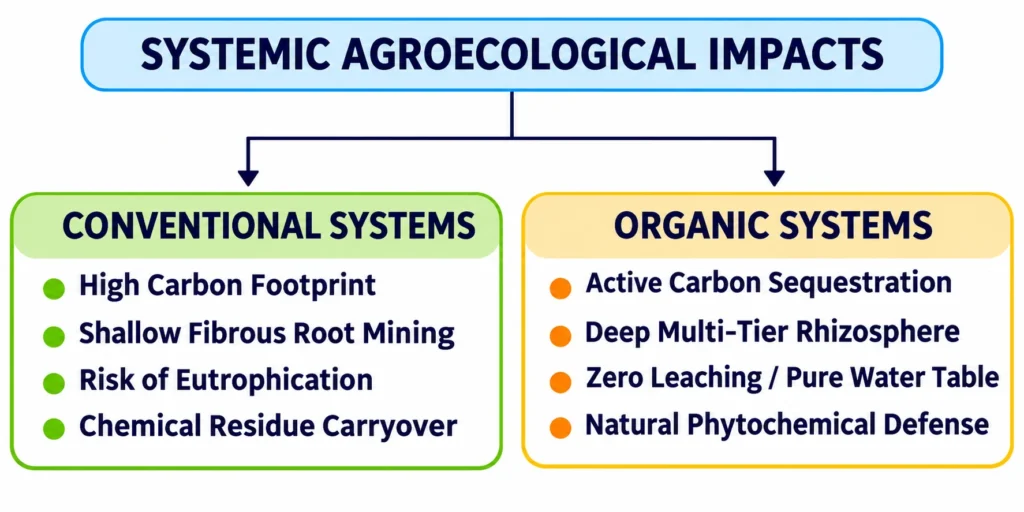
1. Soil Structural Degradation vs. Aggregate Stabilization
- Conventional Pitfalls: The continuous application of high salt-index fertilizers speeds up the mineralization of organic matter, causing subsoil compaction, surface crusting, and soil fatigue.
- Organic Benefits: Regular additions of bulky organic manures build stable clay-humus complexes, which improve soil structure, increase macro-porosity, and boost the soil’s water-use efficiency (WUE).
2. Hydrological Contamination vs. Water Quality Preservation
- Conventional Pitfalls: Synthetic nitrogen and phosphorus runoff easily leaches into aquatic ecosystems, causing high groundwater nitrate toxicities and driving severe eutrophication in surface waters.
- Organic Benefits: Eliminating synthetic chemicals ensures maximum conservation of water quality. This practice keeps aquifers free from chemical residue carryovers and protects aquatic life.
Why Organic Farming is Necessary – UPSC Agriculture Optional
The Strategic Necessity for Organic Transformation
Addressing the Limits of Chemical Agriculture
- Decades of modern chemical agriculture have extracted high crop yields at a severe cost to the environment. The continuous over-application of synthetic fertilizers, chemical herbicides, and broad-spectrum pesticides has triggered widespread soil fatigue, deep aquifer depletion, and a loss of agrobiodiversity.
- Transitioning to a certified organic farming framework is no longer just an alternative methodology; it is an ecological necessity. It serves as a resource-saving, sustainable agriculture framework designed to restore the planet’s biophysical homeostasis.
Core Pillars of Necessity: Multidimensional Impacts
Implementing certified organic practices addresses critical vulnerabilities across the entire food production and supply chain:
1. Restoration of Biophysical Soil Health

- Edaphic Parameter Reconfiguration: Organic farming improves the physical, chemical, and biological health of the soil.
- Physical Health: Adding bulky organic amendments like Farmyard Manure (FYM) and vermicompost builds stable soil macro-aggregates. This re-establishes soil tilth, lowers bulk density, and stops topsoil erosion.
- Chemical Health: It balances the soil’s nutrient status without causing chemical toxicity or altering natural pH parameters.
- Biological Health: It creates a rich environment for beneficial soil organisms, enhancing the population of earthworms and vital micro-flora.
2. Enhancing Produce Quality and Nutritive Value
- Biochemical Enrichment: Organic practices improve the overall quality, shelf life, and nutritive value of farm produce.
- Physiological Balance: Because plants receive balanced, slow-release nutrients rather than forced synthetic nitrogen inputs, they accumulate less structural water and build a higher concentration of dry matter, essential vitamins, antioxidants, and minerals.
- Storage Stability: The lower moisture content in the harvested tissue increases its storage stability and post-harvest shelf life, reducing structural storage losses.
3. Consumer Health Safeguards and Eco-Friendly Technology
- Eliminating Chemical Residues: Conventional farming frequently leaves chemical pesticide residues in the human food chain, causing long-term health hazards. Organic farming safeguards consumer health by completely excluding synthetic toxic inputs.
- Eco-Friendly Technology: It functions as a clean, eco-friendly technology that works in harmony with natural cycles rather than trying to override them with industrial chemicals.
4. Environmental Conservation and Pollution Minimization
- Resource Optimization: It promotes the healthy use of natural resources—such as soil, water, and solar radiation—while minimizing all forms of environmental pollution.
- Hydrological Protection: Eliminating synthetic chemical runoff stops nitrogen and phosphorus leaching into regional water channels, preventing the collapse of aquatic ecosystems through eutrophication.
5. Preserving and Enhancing Biological Diversity
- Agrobiodiversity Fortification: It enhances and sustains biological diversity within the agro-ecosystem.
- Protecting Pollinators: By avoiding toxic synthetic insecticides, it protects keystone pollinators (such as Apis mellifera) and beneficial predatory insects, maintaining a natural ecological balance that keeps pest populations in check.
6. Securing Sustainable Producer Livelihoods
- Economic Resilience: It encourages the sustainable livelihood of producers by reducing their dependence on high-cost, imported corporate inputs.
- Value-Chain Premiums: Farmers can access high-value domestic and international organic trade markets, generating superior net profit margins per hectare and insulating households from single-commodity price crashes.
Principles of Organic Farming – UPSC Agriculture Optional
The Core Philosophical and Agronomic Framework
Institutional Origin
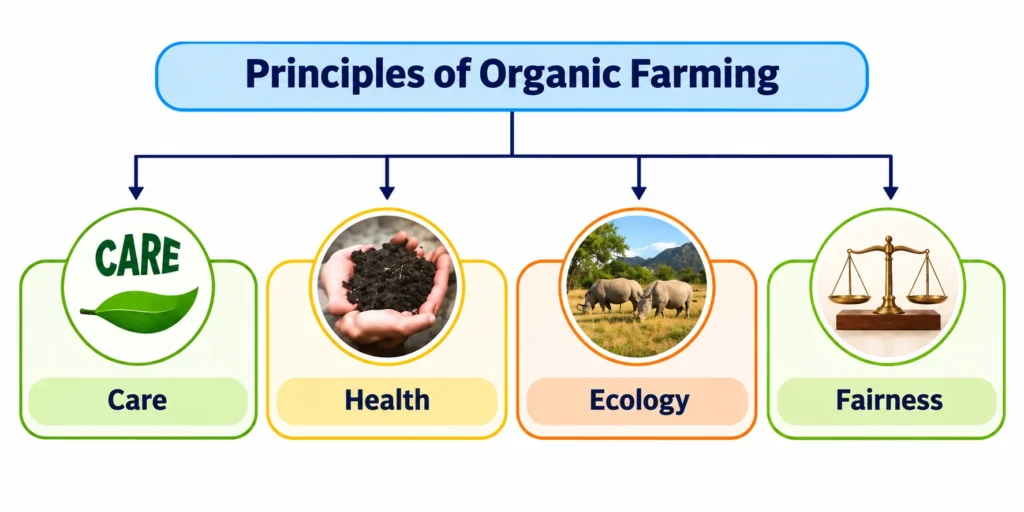
- The foundational architecture of certified organic farming globally is governed by four core principles established by IFOAM (International Federation of Organic Agriculture Movements).
- These tenets are designed to guide the development of agricultural technology choices, ensure sustainable agriculture practices, and maintain the biophysical equilibrium of the agro-ecosystem. They present a holistic production framework that views the planet’s resource boundary as one single, indivisible entity.
The Four General Principles of Organic Agriculture

1. Principle of Health
- Core Mandate: Organic Agriculture should sustain and enhance the health of soil, plant, animal, human, and planet as one and indivisible.
- The Wholeness Paradigm: Health is defined as the wholeness and integrity of living systems. It goes beyond the simple absence of disease to focus on continuous physical, chemical, and biological resilience.
- The Agronomic Link: Healthy soils produce healthy crops that foster the health of animals and people. By avoiding synthetic chemicals, the system preserves the natural immunity of the soil-plant-human food chain.
2. Principle of Ecology
- Core Mandate: Organic Agriculture should be based on living ecological systems and cycles, work with them, emulate them, and help sustain them.
- Agro-Ecological Conditioning: This principle roots organic agriculture within active, living ecological systems. Production must adapt to the specific agro-ecological conditions, climate variations, and nutrient cycles of the local landscape.
- Resource Recycling: Nutrient inputs and pest control must rely on internal recycling and biological balance (e.g., using crop rotation and organic manures) rather than synthetic interventions that cause environmental pollution.
3. Principle of Fairness
- Core Mandate: Organic Agriculture should build on relationships that ensure fairness with regard to the common environment and life opportunities.
- The Equity Standard: Fairness is characterized by equity, respect, justice, and stewardship of the shared world. This applies both among human stakeholders (farmers, laborers, processors, and consumers) and in their relations to other living beings.
- Socioeconomic Resilience: It aims to reduce rural poverty, eliminate human exploitation, and provide fair trade opportunities while securing high-quality food safety and nutritional security across the value chain.
4. Principle of Care
- Core Mandate: Organic Agriculture should be managed in a precautionary and responsible manner to protect the health and well-being of current and future generations and the environment.
- Precautionary Technology Choice: Precaution and responsibility are the key concerns in management, development, and technology choices.
- Risk Mitigation Strategy: Even when a technology promises short-term efficiency, it must be rejected if its long-term impacts are unpredictable or hazardous (e.g., Genetically Modified Organisms / GMOs). The focus remains on choosing methods that protect environmental safety and human health over generation-spanning timelines.

Benefits of Organic Farming – UPSC Agriculture Optional
The Strategic Advantages of Organic Production Systems
Transitioning to a certified organic farming framework delivers multi-trophic benefits across environmental, financial, and consumer safety lines. It serves as a comprehensive sustainable agriculture engine designed to correct the structural vulnerabilities linked to modern chemical agriculture.
Core Systemic and Agronomic Benefits

1. Increase Long-Term Fertility of the Soil
- Humus Matrix Reconfiguration: Organic practices build up soil organic carbon (SOC). Adding bulky organic manures creates stable clay-humus complexes that optimize soil health and gradually increase long-term fertility of the soil.
- Structural Tilth Maintenance: It preserves soil tilth, lowers bulk density, and increases macro-porosity, preventing subsoil hardpan compaction.
2. Maintaining Environmental Health by Reducing Pollution
- Hydrological Safety Nets: Completely excluding synthetic nitrogenous and phosphorus inputs keeps chemical agrochemicals from leaching into regional water channels.
- Preventing Eutrophication: This natural barrier helps in maintaining environment health by reducing the level of pollution, stopping the destructive lifecycle of eutrophication in lakes, ponds, and reservoirs.
3. Reducing Human and Animal Health Hazards
- Eliminating Chemical Residues: Conventional single-crop cultivation relies heavily on broad-spectrum pesticides, which can leave persistent residues in the human food chain.
- Pure Value Chains: Organic farming reduces human and animal health hazards by reducing the level of residues in the product, ensuring clean biochemical pathways across the consumer value chain.
4. Sustaining High Agricultural Production Levels
- Systemic Output Resiliency: This holistic production management system helps in keeping agricultural production at a higher level and makes it sustainable.
- Biological Stability: It relies on diverse biological inputs and functional agrobiodiversity to keep baseline factor productivity steady across successive harvesting cycles.
5. Reducing Production Costs While Improving Soil Health
- Lowering Cash Overheads: By replacing expensive, imported chemical inputs with on-farm biological materials (such as vermicompost, farmyard manure, and green manures), the system reduces the cost of agricultural production and also improves the soil health.
- Resource Re-utilization: This approach helps resource-poor smallholders break away from the high-cost chemical pesticide treadmill loop.
6. Optimum Utilization and Intergenerational Conservation of Natural Resources
- Generational Resource Stewardship: The structural design of organic networks ensures optimum utilization of natural resources for short-term benefit and helps in conserving them for future generations.
- Ecosystem Balance: It achieves an optimum input-output balance, utilizing surface moisture and sunlight efficiently without stripping finite subterranean assets.
7. Saving Operational Energy and Reducing Crop Failure Risks
- Energy Amortization: The system streamlines physical farm management, which saves energy for both animal and machine by reducing the frequency of intensive tillage and chemical spraying runs.
- Risk Spreading: Integrating resilient polycultures and deep-rooted species reduces the risk of total crop failure during sudden climate change anomalies, such as severe drought or erratic monsoonal downpours.
Sustainable Agriculture: Principles, Practices, and Socio-Ecological Dynamics – UPSC Agriculture Optional

Sustainable agriculture is a holistic, ecologically sound approach to farming and food production designed to meet current global demands for food, nutrition, and fiber without compromising the ability of future generations to meet their own needs. It integrates environmental stewardship (ecological health), economic profitability (commercial viability), and social equity (equity for farm labor and rural communities), often referred to as the Triple Bottom Line of sustainable food systems.

Unlike intensive conventional agriculture, which relies on heavy external inputs, sustainable agriculture treats the farm as a structured agro-ecosystem. It prioritizes closed nutrient loops, biological pest regulation, and the preservation of natural resource capital (soil, water, and biodiversity).
Core Pillars of Sustainable Agro-Ecosystems
For an agricultural system to be classified as truly sustainable, it must satisfy three interconnected dimensions:
1. Environmental Stewardship
- Resource Conservation: Minimizing the depletion of non-renewable resources (e.g., fossil-fuel-based synthetic fertilizers and ancient aquifers).
- Pollution Mitigation: Eliminating the leaching of nitrates into groundwater and the run-off of persistent chemical pesticides into aquatic ecosystems.
- Biodiversity Enrichment: Maintaining genetic diverse landraces and fostering beneficial wildlife, insect predators, and soil biota.
2. Economic Profitability
- Input Cost Reduction: Substituting costly external chemical inputs with on-farm biological resources, reducing the farmer’s debt burden.
- Long-Term Asset Protection: Preventing soil erosion and salinization to preserve the monetary value and productive capacity of agricultural land.
- Yield Stability: Buffering the farm against extreme climate events through diversified crop portfolios, ensuring steady financial returns.
3. Social Equity
- Rural Revitalization: Supporting local agricultural economies and generating fair employment opportunities.
- Food Sovereignty and Safety: Providing safe, chemical-free, nutrient-dense food while safeguarding the health of farm workers from chemical toxicities.
- Intergenerational Justice: Ensuring that the natural resource base is passed down to future generations in a functional, productive state.
Key Technological and Agronomic Practices
Transforming conventional farms into sustainable agro-ecosystems requires adopting integrated biological and mechanical practices.
1. Crop Switching and Agro-Ecological Diversification
Crop switching involves shifting from resource-intensive, ecologically mismatched monocultures to crops that fit the local climate and soil profile.
- Replacing Water-Guzzling Monocultures: Transitioning from long-duration paddy fields in semi-arid zones to climate-resilient alternatives like Pearl Millet (Pennisetum glaucum), Sorghum (Sorghum bicolor), and oilseeds.
- Legume Integration: Inserting short-duration pulses like Chickpea (Cicer arietinum) or Pigeonpea (Cajanus cajan) into rotations to naturally fix atmospheric nitrogen via Rhizobium symbiosis.
2. Organic Farming Matrix
Organic farming avoids synthetic fertilizers, growth regulators, and chemical pesticides, relying instead on natural biological cycles.
- Nutrient Management: Utilizing Farmyard Manure (FYM), Vermicompost, and Green Manuring using crops like Dhaincha (Sesbania aculeata) or Sunnhemp (Crotalaria juncea).
- Biological Pest Control: Deploying natural predators like Trichogramma wasps, using biopesticides derived from Neem (Azadirachta indica), and planting trap crops (e.g., marigolds in tomato fields).
3. Community Supported Agriculture (CSA) and Short Supply Chains
CSA is an alternative socioeconomic model that links producers and consumers directly.
- Risk Sharing: Consumers purchase a share of the farm’s anticipated harvest at the start of the season. This provides the farmer with up-front capital and shares the risk of potential crop failures.
- Carbon Footprint Reduction: Minimizing long-distance transportation, packaging, and intermediary exploitation, ensuring that a larger share of consumer spending flows directly back to the rural economy.
4. Conservation Agriculture (CA)
Conservation agriculture uses mechanical and structural interventions to minimize soil disturbance and protect its natural architecture.
- Minimum or Zero Tillage: Retaining the structural integrity of the soil profile, enhancing water infiltration, and cutting tractor fuel usage.
- Permanent In-Situ Soil Cover: Leaving at least 30% of crop residues on the soil surface to act as mulch. This lowers soil temperatures, prevents wind and water erosion, and suppresses weed germination.
Precision Agriculture – UPSC Agriculture Optional
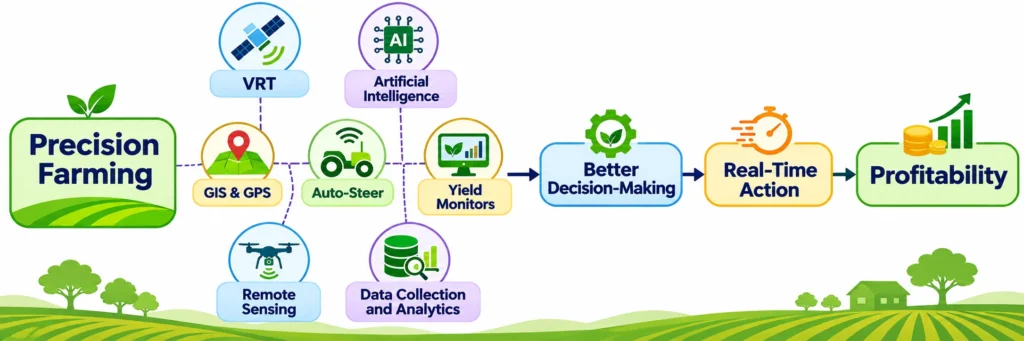
Precision Agriculture (PA), also known as site-specific crop management (SSCM), is an integrated, technology-driven agricultural management system that observes, measures, and responds to inter- and intra-field variability in crops and soils.
Instead of applying uniform agronomic practices across an entire field, precision farming utilizes modern technological tools to ensure that agricultural inputs—such as land, water, seeds, fertilizers, herbicides, and insecticides—are applied at the right time, in the right quantity, and at the exact right location. In essence, it leverages Information and Communication Technologies (ICTs), Wireless Sensor Networks (WSNs), Geospatial methods, and automated positioning systems to enable farmers to use less inputs to grow more output, optimizing both profitability and sustainability.

The Strategic Need for Precision Agriculture in India
Transitioning from conventional blanket-application farming to precision farming is critical for addressing systemic production and ecological challenges in Indian agriculture:
- Reversing Low Crop Productivity: India’s average crop output per hectare remains low compared to global standards. A lack of access to modern technological interventions is a primary bottleneck, making precision interventions highly necessary.
- Optimizing Resource-Use Efficiency: There is an urgent need for the judicious use of water, energy, and critical crop inputs like seeds and agrochemicals to enhance factor productivity and combat resource depletion.
- Harnessing the Rural Digital Revolution: As rural India experiences rapid strides in digital connectivity, establishing a direct link between agricultural productivity, digital applications, and technological innovations is essential to support smallholders.
Core Components and Technological Framework
Precision agriculture operates at the intersection of information, technology, and management. Modern agtech initiatives build upon these fundamental principles to deliver integrated field solutions.
1. Spatial Positioning Systems (GPS & GIS)
- Real-Time Data Orientation: Integrating the Global Positioning System (GPS) and Geographic Information Systems (IS) gives farmers the ability to orient their machinery and field data collection streams in real-time for highly accurate positioning and spatial field management.
- Auto-Steer Machinery Guidance: Auto-steer systems use GIS and GPS coordinates to guide tractors and other farm machinery in uniformly straight lines across fields. This automation enables farmers to till, seed, fertilize, and harvest with precise accuracy, reducing overlapping passes and operator fatigue.
2. Remote Sensing Systems
- Crop Growth and Stress Mapping: Remote sensing utilizes highly sensitive satellite imagery or aerial images collected by drones and planes to identify localized areas of crop growth variability, nutrient deficiencies, water stress, or pest infestations.
- Spatial Geo-Location: Once identified, these precise points of stress are geo-located within the field using GPS coordinates, allowing targeted spot-treatments rather than blanket chemical applications.
3. Artificial Intelligence (AI) and Machine Learning
- Real-Time Input Automation: AI systems use machine learning algorithms to evaluate and respond to real-time agronomic data inputs during field operations.
- Agricultural Robotics: This technology drives modern robotic applications, including automated robotic harvesters and targeted robotic weeding machines that can identify and eliminate weeds mechanically or with micro-doses of herbicide.
4. Data Collection, Analytics, and Variable Rate Systems
- Data-Driven Smart Decisions: Collecting historical data generated during all farm actions and subjecting it to cloud analytics platforms (such as farm management software) provides real-time field insights that guide strategic agronomic decisions.
- Yield Monitors and Yield Mapping: Sensor packages mounted on combine harvesters measure the precise amount of harvest collected alongside real-time GPS and GIS coordinates. This generates comprehensive Yield Maps that are layered with soil maps and Variable Rate Technology (VRT) prescription models to optimize input planning for subsequent cropping seasons.
Advantages of Precision Agriculture – UPSC Agriculture Optional
Precision Agriculture (PA), or site-specific crop management (SSCM), serves as a critical technological pathway to enhance factor productivity, optimize natural resource-use patterns, and stabilize agricultural ecosystems. By treating field spatial variability as a core management metric, it transitions modern farming into an economically remunerative and environmentally sustainable enterprise.

Core Advantages of Site-Specific Systems
1. Enhancing Smallholder Remunerativity and Profitability
- Optimizing the Cost of Cultivation: Precision farming reduces the expenditure on traditional chemical and physical inputs by preventing over-application. This makes agriculture economically viable even for small and marginal farmers.
- Empirical Income Advancements: Real-world implementations underscore this financial impact. For instance, data from mobile-based agricultural extension systems deployed among smallholders in Gujarat demonstrated that precision-led advisory frameworks resulted in an average income increase of ₹7,000 per farmer per year.
2. Maximizing Crop Yield Geometry
- Targeted Plant Architecture Support: Precision tools ensure each individual plant receives the exact quantum of water, macronutrients, and crop protection molecules required for optimal physiological expression.
- Tangible Yield Milestones: Field evaluations highlight significant productivity gains. In localized pilot regions, implementing these technology matrices drove an 8.6% yield increase in Cotton (Gossypium hirsutum) and a 28% yield increase in Cumin (Cuminum cyminum).
3. Fostering Ecological Sustainability and Environmental Protection
- Mitigating Environmental Pollution: Traditional broadcasting creates significant chemical leaching and non-point source water pollution. Site-specific management restricts agrochemical placement directly to target root zones, minimizing chemical runoff into nearby water bodies and safeguarding soil health.
- The Second Green Revolution Paradigm: By systematically delivering “more with less,” precision farming directly aligns with India’s Second Green Revolution objective, driving the core agronomic principle of “More Crop Per Drop.”
4. Smart Governance, Risk Assessment, and Crop Insurance
- Real-Time Canopy and Land Health Audits: Utilizing remote sensing platforms allows for continuous assessment of land degradation parameters, soil moisture gradients, and real-time crop health monitoring.
- Early-Warning Systems: Predictive algorithms generate precise crop forecasts, detailing the extent, type, and severity of biotic and abiotic stress, enabling pro-active pest management interventions.
- Streamlined Post-Event Compensation: During extreme weather events, spatial data mapping acts as an objective verification tool for insurance organizations. This facilitates rapid post-event field evaluation and accelerates the settlement of crop insurance compensation under structural programs.
Precision Agriculture Deployment in India: Current Status
In India, Precision Agriculture (PA) is emerging as a critical frontier to optimize factor productivity and conserve depleting natural capital. While full-scale automated field systems are primarily concentrated in developed economies, India’s approach focuses on adapting these tools to suit a smallholder-dominated landscape. This integration is driven by a combination of public sector research, targeted government schemes, and targeted mobile-led extension networks.

Current Applications and Institutional Framework
1. Government Schemes with Precision Components
- Pradhan Mantri Krishi Sinchayee Yojana (PMKSY) – Per Drop More Crop (PDMC): Focuses on micro-irrigation systems (drip and sprinkler technologies). This framework incorporates fundamental precision principles by utilizing fertigation to deliver water-soluble nutrients directly to the plant root zone, optimizing water-use efficiency [UPSC Notes: Modernizing irrigation is vital, as agriculture consumes over 80% of India’s extracted water].
2. Institutional Research and Smart Innovations
- The SENSAGRI Project: Formulated by the Indian Council of Agricultural Research (ICAR) and the Indian Agricultural Research Institute (IARI), the “SENSAGRI: SENSor-based Smart AGRiculture” initiative develops prototype frameworks integrating internet-of-things (IoT) sensors, unmanned aerial platforms, and ground-based wireless networks to standardize site-specific advisory models.
3. Drone Technology Integration
- Real-Time Scouting and Data Transmission: Unmanned Aerial Vehicles (UAVs/Drones) are deployed to conduct rapid, smooth scouting operations over diverse field layouts. They collect high-resolution multi-spectral canopy reflectance data, transmitting real-time inputs on crop health, water stress, and localized pest infestations.
4. Mobile-Led Extension Systems
- Early Warning Frameworks: Digital smartphone applications function as the primary link to smallholders, translating complex geospatial information into actionable local alerts. These platforms provide farmers with hyper-local weather forecasts, market price trends, and early warning vectors for transboundary pest attacks (e.g., Desert Locust or Fall Armyworm).
Critical Challenges Restricting Large-Scale Adoption
While precision farming is widely adopted in developed Western economies, its expansion across India remains in an early stage due to distinct structural, socio-economic, and demographic bottlenecks:
1. Fragmentation of Land Holdings
- The Scale Inefficiency Barrier: Indian agriculture is overwhelmingly dominated by small and marginal farmers who manage average landholdings of less than 1.08 hectares. Most commercially available precision machinery (such as automated GPS-guided tractors or large combine harvesters equipped with yield monitors) is engineered for expansive, continuous fields, drastically limiting its economic viability on fragmented plots.
2. Infrastructure Deficits and High Initial Capital Costs
- Technological Disconnect: Implementing advanced precision networks requires reliable rural internet connectivity, continuous power supply lines, and local calibration centers. The high initial capital requirement for hardware (e.g., optical sensors, drones, variable-rate applicators) presents a major financial barrier for smallholders without institutional credit backing.
3. Low Risk-Taking Capacity and Demographic Constraints
- Adoption Inertia: Given their low asset baselines, Indian smallholders display a natural disinclination to take financial or operational risks on unproven digital systems. This inertia is often reinforced by lower digital literacy rates and inadequate access to specialized technical training at the grassroots level.
4. Shifting Public Dynamics and Socio-Economic Presses
- Ecosystem Balancing: High population densities and increasing public interest in environmental safety, food quality, and animal welfare mean that any adoption of modern technology must satisfy multiple objectives simultaneously. The primary goal remains boosting net productivity per unit of land, but it must be balanced alongside long-term resource conservation and rural employment safety nets.
Previous Year Question based on it
- Give the specific features of organic farming and natural farming Briefly discuss the preparations and role of biodynamics and cow pat pit in organic crop production. (20M CSE 2023)
- What is “precision farming”? Write its different aspects for resource conservation. (10M, CSE 2022)
- Describe precision agriculture and conservation agriculture. (10M, CSE 2020)
- Define organic farming. Give an account of social, economic, and environmental dimensions of organic farming. (20M, CSE 2019)
- Discuss the economics of organic farming of varied agro-ecological zones of the country. (8M, 150W, IFoS 2019)
- What do you mean by precision farming? Give an account of smart agricultural technologies used in precision farming. (20M, CSE 2019)
- Describe Role of organic farming for sustainability and profitability (10M, 150W, CSE 2018)
- Explain the principles of conservation agriculture. Describe the practices and impact of conservation agriculture in Indian scenario. (10M, CSE 2018)
- What is organic farming? How does it help in sustaining the soil fertility and crop productivity? (20M, CSE 2017)
- Describe Precision farming (10M, 150W, CSE 2017)
- Describe the importance of organic farming with respect to nutritional value addition (10M, 150W, CSE 2014)
- What is organic farming? Should a country like India go for organic farming? Discuss the scope and limitations of organic farming in India. (10M, IFoS-2014)
- What is tillage? Why is zero tillage getting more importance at present? (10M, IFoS-2014)
- Define sustainable agriculture. What are the criteria of sustainability in agriculture system? What are the various approaches to achieve sustainability? (25M, 400W, CSE 2013)
- Protected agriculture (10M, CSE 2016, 2013)
- Short notes on Potential of organic farming in North-Eastern India (15M, 150W, CSE 2010)
- Short notes on Precision in agriculture (20M, 200W, CSE 2007)
- Short notes Organic farming (20M, 200W, CSE 2006, 2001, 1994)